Just to provide some closure with the book, as well as some interesting lingering thoughts, I decide to compile a "follow-up" post. This will contain a few miscellaneous categories such as a few of my favorite quotes, links to articles that make connections between 1984 and today's society, and a letter from George Orwell himself. I hope you have enjoyed the vicarious reading experience through my blog and are eager to read the book for yourself now!
Quotes
"Who controls the past controls the future: who controls the present controls the past"
"Stupidity was as necessary as intelligence and as difficult to attain"
"If he thinks he floats off the floor, and if I simultaneously think I see him do it, then the thing happens."
"Perhaps one did not want to be loved so much as to be understood"
"Perhaps a lunatic was simply a minority of one"
Connections to 2015
This article from CNN, titled, "We're living 1984 today," is worth taking a read. It draws parallels between the National Security Agency and the lack of privacy in the book. Additionally, it pulls key symbols such as telescreens and Newspeak and shows how they are prominent today, but under a different name of course.
George Orwell on 1984
George Orwell wrote this letter before publishing his book. It explains his reasoning for writing as well as gives insights into his predictions for the future. I find it worthwhile to learn the background behind a book, because the context often gives me a new perspective and mindset when revisiting it.
Monday, May 25, 2015

1984: The Movie
After finishing the book, I thought it would be interesting to watch the movie and compare the two. Normally I am not thrilled with the movie versions, either because they cut out major parts of the book or the directors interpret characters or scenes differently than I had. In this case, however, I actually enjoyed the visual enhancement. Here is a link to the trailer to give you a sense of visual perspective. I'm also going to include a few photos from the movie below. Although you haven't yet read the book, I'm sure you have created some images in your mind during the course of reading the blog!


The movie gave a sense of the God-like worship of Big Brother, the barbarianism during the Two Minutes Hate, the intrusive omnipresence of the telescreens, and the sound that constantly bombards the citizens in a way that the book could not convey. I was thoroughly creeped out by the posters and truly felt as though I were immersed in the society.
The entire movie felt like a surveillance of Winston, like we were watching him the same way the Party does. It concurred with my conclusion for why the book is written from a third person standpoint. In addition, the element of sound played a significant role in the movie that was hard to grasp from the words in the book. The contrast between the loud riots and total silence created depth and suspense in the movie. However, even during the moments of silence, it felt as though someone's presence was still always there. For this reason, the whole movie left me feeling on edge, expecting the unexpected at any minute, even though I knew what was going to happen from having read the book.
There were some notable differences between the movie and the book, however, they did not detract from the movie. For starters, everyone refers to each other as 'brother' or 'sister', not comrade. This conveys almost a sense of family among people, similar to the connotation 'Big Brother' has, yet is completely ironic in context. The society wants to eradicate the idea of marriage, union, and having children. This idea of lovingness was further developed between O'Brien and Winston, while he was in the process of re-integration. In between physically brutal conditioning sessions, O'Brien would touch Winston's hand or hold him in his arms, as though lovingly nurturing him. Again, I found this to be ironic, and played up more so in the movie than in the book. It served the purpose of showing how the rulers are also trying to take over the role of raising and the malleable children. Overall, the dynamic between governmental officials and their people is quite bizarre.
The last lingering question I have for both the book and the movie is what the significance of chess is? The game was played multiple times in both mediums and I could not determine if there was a symbolic meaning of it. I considered applying it to the idea of victory, of thinking steps ahead into the future, and whether the traditional black and white pieces were a continuation of the contrasting motifs of light and dark. Perhaps I am simply reading too much into this, who knows, or maybe another thought will come to me during a re-read or re-watch someday.

Big Brother
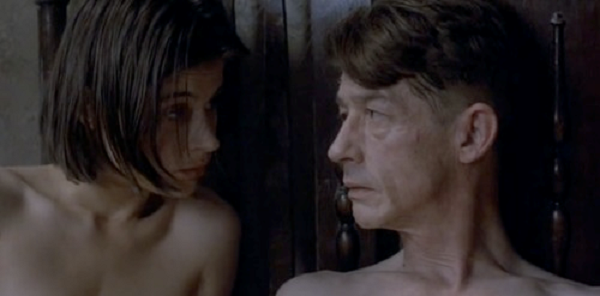
Winston and Julia

Winston's torture
The entire movie felt like a surveillance of Winston, like we were watching him the same way the Party does. It concurred with my conclusion for why the book is written from a third person standpoint. In addition, the element of sound played a significant role in the movie that was hard to grasp from the words in the book. The contrast between the loud riots and total silence created depth and suspense in the movie. However, even during the moments of silence, it felt as though someone's presence was still always there. For this reason, the whole movie left me feeling on edge, expecting the unexpected at any minute, even though I knew what was going to happen from having read the book.
There were some notable differences between the movie and the book, however, they did not detract from the movie. For starters, everyone refers to each other as 'brother' or 'sister', not comrade. This conveys almost a sense of family among people, similar to the connotation 'Big Brother' has, yet is completely ironic in context. The society wants to eradicate the idea of marriage, union, and having children. This idea of lovingness was further developed between O'Brien and Winston, while he was in the process of re-integration. In between physically brutal conditioning sessions, O'Brien would touch Winston's hand or hold him in his arms, as though lovingly nurturing him. Again, I found this to be ironic, and played up more so in the movie than in the book. It served the purpose of showing how the rulers are also trying to take over the role of raising and the malleable children. Overall, the dynamic between governmental officials and their people is quite bizarre.
The last lingering question I have for both the book and the movie is what the significance of chess is? The game was played multiple times in both mediums and I could not determine if there was a symbolic meaning of it. I considered applying it to the idea of victory, of thinking steps ahead into the future, and whether the traditional black and white pieces were a continuation of the contrasting motifs of light and dark. Perhaps I am simply reading too much into this, who knows, or maybe another thought will come to me during a re-read or re-watch someday.
Lessons from Big Brother
As a way of summarizing the main themes of the book, I decided to make a list of the five most important bits of information that Big Brother wants you to know. Essentially, if you reverse what these lessons say, then you will find something useful. That's because everything in this society is practically backwards. Each of these covers a different aspect of the society and leads us to themes about the book as a whole.
1) Two plus two equals five
No, not four. Five. I don't care what the logic in your head tells you after you put two sets of two fingers together. Two and two makes five. Learn it.
2) War maintains social structure
By staying at war, we are essentially at peace, because everything stays orderly and productive. No one has free time to contemplate thoughts of rebellion or ideas of innovation. This is the way it shall remain in order to keep everyone in their proper place.
3) The past can be altered
The past only exists through memories and records. By deleting old records and forgetting certain memories, the past no longer exists. It can be rewritten and changed for the better or worse, depending on what we want it to be or convey.
4) Suffering leads to conformity
Suffering is enough to bring a person to obedience. When in extreme pain, a person's survival instincts kick in and they are willing to do most anything to stay alive. Therefore, in order to control even the most stubborn non-conformists, physical torture is a necessity.
5) Thinking is a crime
Thinking leads to individualism which counter's our very goals. We strive to make sure all people are the same for they are much easier to control when uniform. If anyone commits the crime of thinking they will be punished severely and publicly to make the consequences clear to others as well.
Takeaway
From these we can see how integral violence and mind control are to the society. By making everyone the same, there is no one that has the knowledge or capability to rebel. This becomes cyclical and destroys all hope of the society ever changing. What we can learn from this is to recognize similar patterns in our own society. Is there constant war that people claim is the "answer"? Is there a follow-the-crowd mentality that everyone is blindly following and not bothering to question? These are the questions that 1984 teaches us to ask. We cannot be a society full of gullibile, over-accepting people or else we run the risk of being taken over. We must maintain a sense of love and unity, while still viewing the world with a critical eye. Furthermore, we must use the past as a window to the future, for if we do not learn from our mistakes we are destined to repeat them. Therefore, even though this book seems extreme and far from today's society, it has elements that could become reality if we do not pay attention and stay informed citizens. Take this book as a guide and use it as a warning for the future, so we do not end up under the rule of our own Big Brother.
1) Two plus two equals five
No, not four. Five. I don't care what the logic in your head tells you after you put two sets of two fingers together. Two and two makes five. Learn it.
2) War maintains social structure
By staying at war, we are essentially at peace, because everything stays orderly and productive. No one has free time to contemplate thoughts of rebellion or ideas of innovation. This is the way it shall remain in order to keep everyone in their proper place.
3) The past can be altered
The past only exists through memories and records. By deleting old records and forgetting certain memories, the past no longer exists. It can be rewritten and changed for the better or worse, depending on what we want it to be or convey.
4) Suffering leads to conformity
Suffering is enough to bring a person to obedience. When in extreme pain, a person's survival instincts kick in and they are willing to do most anything to stay alive. Therefore, in order to control even the most stubborn non-conformists, physical torture is a necessity.
5) Thinking is a crime
Thinking leads to individualism which counter's our very goals. We strive to make sure all people are the same for they are much easier to control when uniform. If anyone commits the crime of thinking they will be punished severely and publicly to make the consequences clear to others as well.
Takeaway
From these we can see how integral violence and mind control are to the society. By making everyone the same, there is no one that has the knowledge or capability to rebel. This becomes cyclical and destroys all hope of the society ever changing. What we can learn from this is to recognize similar patterns in our own society. Is there constant war that people claim is the "answer"? Is there a follow-the-crowd mentality that everyone is blindly following and not bothering to question? These are the questions that 1984 teaches us to ask. We cannot be a society full of gullibile, over-accepting people or else we run the risk of being taken over. We must maintain a sense of love and unity, while still viewing the world with a critical eye. Furthermore, we must use the past as a window to the future, for if we do not learn from our mistakes we are destined to repeat them. Therefore, even though this book seems extreme and far from today's society, it has elements that could become reality if we do not pay attention and stay informed citizens. Take this book as a guide and use it as a warning for the future, so we do not end up under the rule of our own Big Brother.
AP Worthy?
What a captivating and thought-provoking book. 1984 had elements of suspense, romance, political and science fiction, all interwoven to make this dystopian novel universally appealing. No doubt it was a great, but does it stand the test of being deemed "AP worthy"? The AP Literature curriculum intends to prepare students to read and analyze more challenging and sophisticated texts, to be able to delve between the lines, and to interpret what the author wants readers to understand. So in order to assume the title of being "AP worthy", a book needs to provide sufficient practice for identifying symbols, motifs, and themes, as well as recognizing allusions and other literary devices. It also needs to be applicable to a variety of open-response prompts that occur at the end of every exam.
1984, a winner of the Prometheus Best Novels Award, is far from being a purely plot-based book. There are subtle allusions as in the rhymes, symbols and motifs such as the paperweight and singing, complex characters like two-faced O'Brien, and messages that stem from both internal and external conflicts. Furthermore, the content of the book remains relevant today. We see pieces of their society in ours and often hear the referenced line "Big Brother is watching you." This book serves as a reminder of what we don't want our world to look like in the future. Therefore, 1984's literary layers and timeless topic make it deserving of being an AP book.
Open Response Prompts
-Big Brother, the omnipresent symbol of the Party
Thesis:
Big Brother seems to be everywhere, yet nowhere at the same time. We only see ever him through his picture on posters, cigarettes, banners, and screens, never in person. Yet, everyone blindly follows this leader of theirs without even questioning his existence. His character serves the purpose of representing the society, in addition to revealing the brainwashed nature of its people.
Support:
-Big Brother controls people's minds and tells them what to think no matter how much it contradicts logic, ex) 2 + 2 =5
-Releases unreliable information and statistics that no one questions, ex) wars, rations, production
-People blindly go along with Hate Week and Two Minutes Hate because Big Brother says to
-Thoughtcrime for not loving Big Brother
-Winston betraying Julia
Thesis:
Betraying Julia is something Winston promises to never do. While talking with O'Brien during their first meeting, he agrees to put himself in harm's way and endure most anything, so long as it does not involve breaking his loyalty to her. That all changes when he is about to have his head submerged in a cage full of rats and pleas to have it done to her instead. This act of betrayal shows the power of society to corrupt its people.
Support:
-O'Brien's initial meeting with Winston vs at the Ministry of Love after arrest
-Winston saying Julia doesn't actually mean that much to him
-O'Brien manipulating him to the point he gives in
-Winston's change in character
-Winston
Thesis:
On the outside Winston appears to live the same as everyone else in the society, however, when he is out of sight of the telescreens and microphones, he expresses his internal questioning of the society. This conflict goes to show how mentally destructive a society is that attempts to totally control its people.
Support:
-Winston writing in diary and thinking freely
-Struggling to see logic in what he's being fed
-Visiting Proles to find out about past; "did it used to be better than it is now?"
-At the Ministry of Love struggling to believe
-The Party
Thesis:
The Party rules Oceania with the principles of Ingsoc. Their power-hungry motivation is purely selfish and all they want is control for the sake of having control over others. Their power struggle demonstrates how people's intentions become corrupt when they act in a selfish manner.
Support:
-Vaporizations to quell rebellion
-People of the Inner Party live luxurious lives, ex) O'Brien's house
-Emmanuel Goldstein's book about Oligarchial Collectivism
-Limit supply keep people impoverished and feed information to keep people uneducated
1984, a winner of the Prometheus Best Novels Award, is far from being a purely plot-based book. There are subtle allusions as in the rhymes, symbols and motifs such as the paperweight and singing, complex characters like two-faced O'Brien, and messages that stem from both internal and external conflicts. Furthermore, the content of the book remains relevant today. We see pieces of their society in ours and often hear the referenced line "Big Brother is watching you." This book serves as a reminder of what we don't want our world to look like in the future. Therefore, 1984's literary layers and timeless topic make it deserving of being an AP book.
Open Response Prompts
1994. In some works of literature, a character who appears briefly, or does not appear at all, is a significant presence. Choose a novel or play of literary merit and write an essay in which you show how such a character functions in the work. You may wish to discuss how the character affects action, theme, or the development of other characters. Avoid plot summary.Character:
-Big Brother, the omnipresent symbol of the Party
Thesis:
Big Brother seems to be everywhere, yet nowhere at the same time. We only see ever him through his picture on posters, cigarettes, banners, and screens, never in person. Yet, everyone blindly follows this leader of theirs without even questioning his existence. His character serves the purpose of representing the society, in addition to revealing the brainwashed nature of its people.
Support:
-Big Brother controls people's minds and tells them what to think no matter how much it contradicts logic, ex) 2 + 2 =5
-Releases unreliable information and statistics that no one questions, ex) wars, rations, production
-People blindly go along with Hate Week and Two Minutes Hate because Big Brother says to
-Thoughtcrime for not loving Big Brother
2007, Form B. Works of literature often depict acts of betrayal. Friends and even family may betray a protagonist; main characters may likewise be guilty of treachery or may betray their own values. Select a novel or play that includes such acts of betrayal. Then, in a well-written essay, analyze the nature of the betrayal and show how it contributes to the meaning of the work as a whole.Betrayal:
-Winston betraying Julia
Thesis:
Betraying Julia is something Winston promises to never do. While talking with O'Brien during their first meeting, he agrees to put himself in harm's way and endure most anything, so long as it does not involve breaking his loyalty to her. That all changes when he is about to have his head submerged in a cage full of rats and pleas to have it done to her instead. This act of betrayal shows the power of society to corrupt its people.
Support:
-O'Brien's initial meeting with Winston vs at the Ministry of Love after arrest
-Winston saying Julia doesn't actually mean that much to him
-O'Brien manipulating him to the point he gives in
-Winston's change in character
2005. In Kate Chopin’s The Awakening (1899), protagonist Edna Pontellier is said to possess “That outward existence which conforms, the inward life that questions.” In a novel or play that you have studied, identify a character who outwardly conforms while questioning inwardly. Then write an essay in which you analyze how this tension between outward conformity and inward questioning contributes to the meaning of the work. Avoid mere plot summary.Character:
-Winston
Thesis:
On the outside Winston appears to live the same as everyone else in the society, however, when he is out of sight of the telescreens and microphones, he expresses his internal questioning of the society. This conflict goes to show how mentally destructive a society is that attempts to totally control its people.
Support:
-Winston writing in diary and thinking freely
-Struggling to see logic in what he's being fed
-Visiting Proles to find out about past; "did it used to be better than it is now?"
-At the Ministry of Love struggling to believe
2005, Form B. One of the strongest human drives seems to be a desire for power. Write an essay in which you discuss how a character in a novel or a drama struggles to free himself or herself from the power of others or seeks to gain power over others. Be sure to demonstrate in your essay how the author uses this power struggle to enhance the meaning of the work.Character:
-The Party
Thesis:
The Party rules Oceania with the principles of Ingsoc. Their power-hungry motivation is purely selfish and all they want is control for the sake of having control over others. Their power struggle demonstrates how people's intentions become corrupt when they act in a selfish manner.
Support:
-Vaporizations to quell rebellion
-People of the Inner Party live luxurious lives, ex) O'Brien's house
-Emmanuel Goldstein's book about Oligarchial Collectivism
-Limit supply keep people impoverished and feed information to keep people uneducated
Big Brother Forever
Imagine yourself in a room, where overhead lights constantly beat down on you, day and night. There are no windows and you have no conception of time. If you make the slightest wrong movement, the telescreen will bark orders at you, commanding you to assume a standard position. The people around you wear expressions of fear, of hatred, of denial. You are all in the room for the same reason: crime against the Party. Hunger begins to gnaw at your stomach, and your main priority becomes instinctively to stay alive as those around begin to disappear one by one to a mysterious Room 101.
These are the circumstances Winston faces in the Ministry of Love following his arrest. All hope he has for the future vanishes and any trust in O'Brien ceases, for he is the man behind the whole set up. For seven years, O'Brien had spied on Winston, waiting for the perfect time to turn him in. After doing just that, he puts Winston through intense physical beatings and mind manipulation, all in effort to conform his brain before either shooting him or setting him free.
Winston defies at first, but eventually gives up during the second and third stages of his "reintegration process," understanding and accepting. After all, isn't it much easier to just conform- to love Big Brother and accept their logic, no matter how much it goes against every thought in your mind? He now believes two and two actually make five. He believes the history the Party feeds him is true. He believes doublethink is natural. During this process, he even betrays Julia in effort to save himself in Room 101 from his worst nightmare: a cage of rats eager to eat his face off. Needless to say, the Party succeeds in the end. They corrupt his mind and take control over him the way they do with everyone else.
Big Brother forever. The End.
These are the circumstances Winston faces in the Ministry of Love following his arrest. All hope he has for the future vanishes and any trust in O'Brien ceases, for he is the man behind the whole set up. For seven years, O'Brien had spied on Winston, waiting for the perfect time to turn him in. After doing just that, he puts Winston through intense physical beatings and mind manipulation, all in effort to conform his brain before either shooting him or setting him free.
Winston defies at first, but eventually gives up during the second and third stages of his "reintegration process," understanding and accepting. After all, isn't it much easier to just conform- to love Big Brother and accept their logic, no matter how much it goes against every thought in your mind? He now believes two and two actually make five. He believes the history the Party feeds him is true. He believes doublethink is natural. During this process, he even betrays Julia in effort to save himself in Room 101 from his worst nightmare: a cage of rats eager to eat his face off. Needless to say, the Party succeeds in the end. They corrupt his mind and take control over him the way they do with everyone else.
Big Brother forever. The End.
Sunday, May 24, 2015
Part II: secrets and spoilers
As I write this, I am still processing all that has just occurred- plot twists, new characters, and more explanations. This post will re-cap Part II as well as further develop some of the symbols, themes, and characters from the Part I post. (*Fair warning, as indicated by the title, there are going to be spoilers. It would be impossible to analyze this section without giving the story away.)
Let's jump right in and begin with O'Brien, a man who we now know to be a member of the Brotherhood disguised as a member of the Inner Party. His character serves as a representative of this counter-movement, a person with inside-access who would never be suspected of disobeying. He plays the game of the Party intelligently, and is therefore able to outsmart it. O'Brien inspires Winston and passes on his knowledge in the form of a book by the one and only Emmanuel Goldstein titled "The Theory and Practice of Oligarchial Collectvism." It provides a window to the past in how the world did not always used to be like this. Starvation didn't prevail, war did not constantly take place, and people were not always conditioned to not think. It also ties the current state of the society to its famous slogan "Ignorance is Strength, Freedom is Slavery, War is Peace."
The book provides an explanation for how the society keeps its people ignorant by teaching them what to think and what words to think with. This essentially leaves no room for creativity or discovery or invention, which is what advancement depends on. Anyone who does not conform to this mentality gets killed off, which sends out a message to others about what will happen if they do the same. The book also provides an explanation for the line about war being peace. Goldstein starts with how the Party tries to keep everyone working all the time. In doing so, people have less time on their hands to think about revolution, and are instead being productive members of the Party. To use up this surplus of goods, which the Party would never dream of giving to people because it wants everyone to be impoverished to some degree, it stays in a constant state of war. However, the war is not really a war, because each of the three super-states that fight each other are self-sufficient and stable politically and economically. Therefore, it is more of a game that keeps everyone in a constant state of fear, poverty, and governmental dependence, and in turn maintains the societal structure and strength. The only problems the super-state must constantly strive to solve are "how to discover, against his will, what another human being is thinking, and how to kill several hundred million people in a few seconds without giving warning beforehand" (201). Pretty twisted, right? Well, that sums up the society as a whole. We are left with a good picture of how this society operates, yet, as Winston puts it, we are still unsure of why.
Additionally, Goldstein provides some insights that tie up loose ends from the last section. First of all, he clues in Winston to how the rhyme ends.
Another interesting component of this section is the continuation of the contrast between light and dark. At one point, Winston says how they are fighting in the dark, meaning they are blind to what the outcome will be in the future. The most notable scene that features this contrast is when Winston says to O'Brien that they should meet again "in the place where there is no darkness" (185). This is actually foreshadowed earlier in the book during one of Winston's dreams. It is an ironic reference to the Ministry of Love, because they always have lights on and are supposed to concern themselves with love, but actually concern themselves with torturing people. The darkness continues to represent uncertainty, fear, and hatred, but light is now also negatively associated with torture and pain, instead of representing freedom, peace, and hope. Light and dark seem to intertwine in the book, symbolizing the inability people in the society have to distinguish wrong from right and truth from falsehood. It gives readers less hope for the society's future.
Singing is another motif worth pointing out. People, especially the Proles who follow the unconsciously follow the party, sing almost constantly. I guarantee that half the people don't even know what they are singing about, though. It is a way for them to communicate still and reminds me almost of a historical reference to slaves singing in fields. The Proles are comparable to slaves in the society and their singing is a pleasant way for them to communicate. After all, you don't see members of the Inner Party walking around singing. In addition, singing is seen through the bird that whistles during Julia and Winston's first meeting in the woods. That, too, symbolizes the recognition of their societal defiance and freedom and, ultimately, hope.
Okay, now I think I have covered most of it- O'Brien and the Brotherhood, Emmanuel Goldstein's book, the mysterious rhyme, and singing and light/dark motifs. To wrap this up, I will leave you hanging on the same cliff hanger I am on. Prepare yourself for this! Julia and Winston just got caught. They are surrounded by men, voices are telling them to put their hands up, and Mr. Charrington's true identity as a member of the Thought Police just got revealed. Part III is about to get interesting, so check back soon to see what becomes of this situation as the book comes to a close.
Let's jump right in and begin with O'Brien, a man who we now know to be a member of the Brotherhood disguised as a member of the Inner Party. His character serves as a representative of this counter-movement, a person with inside-access who would never be suspected of disobeying. He plays the game of the Party intelligently, and is therefore able to outsmart it. O'Brien inspires Winston and passes on his knowledge in the form of a book by the one and only Emmanuel Goldstein titled "The Theory and Practice of Oligarchial Collectvism." It provides a window to the past in how the world did not always used to be like this. Starvation didn't prevail, war did not constantly take place, and people were not always conditioned to not think. It also ties the current state of the society to its famous slogan "Ignorance is Strength, Freedom is Slavery, War is Peace."
The book provides an explanation for how the society keeps its people ignorant by teaching them what to think and what words to think with. This essentially leaves no room for creativity or discovery or invention, which is what advancement depends on. Anyone who does not conform to this mentality gets killed off, which sends out a message to others about what will happen if they do the same. The book also provides an explanation for the line about war being peace. Goldstein starts with how the Party tries to keep everyone working all the time. In doing so, people have less time on their hands to think about revolution, and are instead being productive members of the Party. To use up this surplus of goods, which the Party would never dream of giving to people because it wants everyone to be impoverished to some degree, it stays in a constant state of war. However, the war is not really a war, because each of the three super-states that fight each other are self-sufficient and stable politically and economically. Therefore, it is more of a game that keeps everyone in a constant state of fear, poverty, and governmental dependence, and in turn maintains the societal structure and strength. The only problems the super-state must constantly strive to solve are "how to discover, against his will, what another human being is thinking, and how to kill several hundred million people in a few seconds without giving warning beforehand" (201). Pretty twisted, right? Well, that sums up the society as a whole. We are left with a good picture of how this society operates, yet, as Winston puts it, we are still unsure of why.
Additionally, Goldstein provides some insights that tie up loose ends from the last section. First of all, he clues in Winston to how the rhyme ends.
" 'Oranges and lemons,' say the bells of St Clement's,That last line instantly shows why the Party does not want anyone to have any recollection of the the latter half. The idea of 'growing rich' is something that the Party does not want implemented in any of its followers' minds. The Party strives to keep everyone in their own low-middle classes and not have any economic mobility for this connotes thinking for themselves and finding a way to increase their status. Overall, the main purpose of including this rhyme in the book is to show the society's repressive nature and to also provide a connection to the past through the allusions to the churches.
'You owe me three farthings,' say the bells of St Martin's,
'When will you pay me?' say the bells of Old Bailey,
'When I grow rich,' say the bells of Shoreditch." (186)
Another interesting component of this section is the continuation of the contrast between light and dark. At one point, Winston says how they are fighting in the dark, meaning they are blind to what the outcome will be in the future. The most notable scene that features this contrast is when Winston says to O'Brien that they should meet again "in the place where there is no darkness" (185). This is actually foreshadowed earlier in the book during one of Winston's dreams. It is an ironic reference to the Ministry of Love, because they always have lights on and are supposed to concern themselves with love, but actually concern themselves with torturing people. The darkness continues to represent uncertainty, fear, and hatred, but light is now also negatively associated with torture and pain, instead of representing freedom, peace, and hope. Light and dark seem to intertwine in the book, symbolizing the inability people in the society have to distinguish wrong from right and truth from falsehood. It gives readers less hope for the society's future.
Singing is another motif worth pointing out. People, especially the Proles who follow the unconsciously follow the party, sing almost constantly. I guarantee that half the people don't even know what they are singing about, though. It is a way for them to communicate still and reminds me almost of a historical reference to slaves singing in fields. The Proles are comparable to slaves in the society and their singing is a pleasant way for them to communicate. After all, you don't see members of the Inner Party walking around singing. In addition, singing is seen through the bird that whistles during Julia and Winston's first meeting in the woods. That, too, symbolizes the recognition of their societal defiance and freedom and, ultimately, hope.
Okay, now I think I have covered most of it- O'Brien and the Brotherhood, Emmanuel Goldstein's book, the mysterious rhyme, and singing and light/dark motifs. To wrap this up, I will leave you hanging on the same cliff hanger I am on. Prepare yourself for this! Julia and Winston just got caught. They are surrounded by men, voices are telling them to put their hands up, and Mr. Charrington's true identity as a member of the Thought Police just got revealed. Part III is about to get interesting, so check back soon to see what becomes of this situation as the book comes to a close.
Saturday, May 23, 2015
Questions, Answered
I am a little over the half-way point and am finally starting to get some answers to my questions. I wouldn't go so far as to say the books is tying up loose ends, but it is definitely revealing a bit more.
Who is this mysterious, dark-haired girl?
Her name is Julia, and she is a rebellious 26 year-old who pretends to conform to the society by participating in the Junior Anti-Sex League and performing her duties at the Fiction Department. Oh, and she is in love with Winston. Yes, that last bit is true, believe it or not. She slipped him a note one day after he helped her up from a fall that read "I love you" (113). Before this occurrence, they had only laid eyes on each other once or twice, let alone spoken a full conversation. Her confession marked a dramatic shift in the story and now she has become an integral character. She and Winston are always planning secret meetings, trying to communicate without being caught by the telescreens, and experimenting with the desires they are deprived of. Winston says how "she ha[s] become a physical necessity, something that he not only wanted but felt that he had a right to" (146). They kiss and have sex multiple times, always feeling "their embrace had been a battle, the climax a victory...a blow struck against the Party...a political act" (133). By allowing themselves to acknowledge their lust and do something that the society discourages, they feel they are sparking change in a sense. As Julia puts it:
Why is the book written from a third person perspective?
At first, I struggled to find meaning in this stylistic choice. It found it strange that this book does not utilize first person from Winston's perspective. Then, in the last 20 pages or so, a possible explanation hit me: reading this book feels as though we, as readers, are spying on Winston. The detached yet close standpoint creates a sense of invading the privacy of Winston's life. Doesn't this sound familiar? This is exactly what the telescreens do, they spy on Winston and get a very good sense of what is going on, yet they are not fully submerged in his life because he manages to escape them at points. Therefore, the style of the book mirrors the happenings in the society regarding surveillance.
What is up with his ulcer?
This ulcer is a varicose ulcer located on his ankle that frequently itches. I tried to look for connections between time of day, certain events, and other indicators that would give me a better sense of its meaning. However, since he has been meeting with Julia, it hasn't been mentioned, so my search for clues has come to a halt. Interestingly, I decided to use this itself as a clue. Itches are something that need to be scratched, an annoying sensation that requires immediate attention. When he's with Julia, he is practically in a state of release, not holding feelings inside and wanting desperately to rebel. Therefore, perhaps his ulcer is symbolic of his emotions while under control of the Party.
What do the rhymes mean?
The most prominent rhyme starts, "'Oranges and lemons,' say the bells of St Clement's, 'You owe my three farthing,' say the bells of St Martin's-" (102). However, no one seems to remember the middle. After searching this rhyme on the Internet, I have come to learn it is an English nursery rhyme that contains an allusion to the Great Fire of London in 1666, which destroyed a famous church. I am still unsure of the connection, but I do know that oranges and lemons are not prevalent in Airstrip One. Hopefully the coming sections give more indication of its deeper meaning.
What is the significance of the glass paperweight?
Winston bought the glass paperweight with a coral center at Mr. Charrington's shop, the same place where he bought his diary. "The inexhaustibly interesting thing was not the fragment of coral but the interior of the glass itself. There was such a depth of it, and yet it was almost transparent as air. It was as though the surface of the glass had been the arch of the sky, enclosing a tiny world with its atmosphere complete. [Winston] had the feeling that he could get inside it, and that in fact he was inside it, along with the mahogany bed and the gate-leg table, and the clock and the steel engraving and the paperweight itself. The paperweight was the room he was in, and the coral was Julia's life and his own, fixed in sort of eternity at the heart of the crystal" (154). Aside from loving the way this passage is written, I found it provided an immense amount of insight into this small, yet symbolic token. It shows the emotional growth Winston has experienced, and the budding relationship between him and Julia.
How did this society come to existence?
"The story really began in the middle 'sixties, the period of the great purges in which the original leaders of the Revolution were wiped out once and for all. By 1970 none of them was left, except Big Brother himself. All the rest had by that time been exposed as traitors or counter-revolutionaries" (78). So there is the big answer, or at least part of it. War, and presumably the turmoil that came with it, left everyone in search of leadership to assuage their fears and promise restoration and order. Big Brother seemed like a hopeful option, and so his reign began. From there, the society only went downhill. This isn't the first time we have heard of a story like this. It reminds me of Germany during the time of the NAZI's after Hitler came to power. He provided everyone a glimmer of hope at mending the economic state and lingering devastation from World War I. Little did everyone know that his sole intent was to take advantage of and manipulate them just like Big Brother. Interestingly, this book was written in 1949 and Hitler came to power in 1933. Connection? I think so.
Who is this mysterious, dark-haired girl?
Her name is Julia, and she is a rebellious 26 year-old who pretends to conform to the society by participating in the Junior Anti-Sex League and performing her duties at the Fiction Department. Oh, and she is in love with Winston. Yes, that last bit is true, believe it or not. She slipped him a note one day after he helped her up from a fall that read "I love you" (113). Before this occurrence, they had only laid eyes on each other once or twice, let alone spoken a full conversation. Her confession marked a dramatic shift in the story and now she has become an integral character. She and Winston are always planning secret meetings, trying to communicate without being caught by the telescreens, and experimenting with the desires they are deprived of. Winston says how "she ha[s] become a physical necessity, something that he not only wanted but felt that he had a right to" (146). They kiss and have sex multiple times, always feeling "their embrace had been a battle, the climax a victory...a blow struck against the Party...a political act" (133). By allowing themselves to acknowledge their lust and do something that the society discourages, they feel they are sparking change in a sense. As Julia puts it:
"When you make love your're using up energy; and afterwards you feel happy and don't give a damn for anything. they can't bear to feel like that. They want you to be bursting with energy all the time. All this marching up and down and cheering and waving flags is simply sex gone sour. If you're happy inside yourself, why should you get excited about Big Brother and the Three-Year Plans and the Two Minutes Hate and all the rest of their bloody rot?" (139)Julia further draws out Winston's desire to rebel and sparks greater development. He now feels comfortable sneaking out of town on some unknown route to meet up with her and then enjoying the forbidden goods such as coffee, sugar, and chocolate that she has presumably stolen from the Inner Party. I am eager to find out what becomes of their relationship, because I predict they will get caught at some point.
Why is the book written from a third person perspective?
At first, I struggled to find meaning in this stylistic choice. It found it strange that this book does not utilize first person from Winston's perspective. Then, in the last 20 pages or so, a possible explanation hit me: reading this book feels as though we, as readers, are spying on Winston. The detached yet close standpoint creates a sense of invading the privacy of Winston's life. Doesn't this sound familiar? This is exactly what the telescreens do, they spy on Winston and get a very good sense of what is going on, yet they are not fully submerged in his life because he manages to escape them at points. Therefore, the style of the book mirrors the happenings in the society regarding surveillance.
What is up with his ulcer?
This ulcer is a varicose ulcer located on his ankle that frequently itches. I tried to look for connections between time of day, certain events, and other indicators that would give me a better sense of its meaning. However, since he has been meeting with Julia, it hasn't been mentioned, so my search for clues has come to a halt. Interestingly, I decided to use this itself as a clue. Itches are something that need to be scratched, an annoying sensation that requires immediate attention. When he's with Julia, he is practically in a state of release, not holding feelings inside and wanting desperately to rebel. Therefore, perhaps his ulcer is symbolic of his emotions while under control of the Party.
What do the rhymes mean?
The most prominent rhyme starts, "'Oranges and lemons,' say the bells of St Clement's, 'You owe my three farthing,' say the bells of St Martin's-" (102). However, no one seems to remember the middle. After searching this rhyme on the Internet, I have come to learn it is an English nursery rhyme that contains an allusion to the Great Fire of London in 1666, which destroyed a famous church. I am still unsure of the connection, but I do know that oranges and lemons are not prevalent in Airstrip One. Hopefully the coming sections give more indication of its deeper meaning.
What is the significance of the glass paperweight?
Winston bought the glass paperweight with a coral center at Mr. Charrington's shop, the same place where he bought his diary. "The inexhaustibly interesting thing was not the fragment of coral but the interior of the glass itself. There was such a depth of it, and yet it was almost transparent as air. It was as though the surface of the glass had been the arch of the sky, enclosing a tiny world with its atmosphere complete. [Winston] had the feeling that he could get inside it, and that in fact he was inside it, along with the mahogany bed and the gate-leg table, and the clock and the steel engraving and the paperweight itself. The paperweight was the room he was in, and the coral was Julia's life and his own, fixed in sort of eternity at the heart of the crystal" (154). Aside from loving the way this passage is written, I found it provided an immense amount of insight into this small, yet symbolic token. It shows the emotional growth Winston has experienced, and the budding relationship between him and Julia.
How did this society come to existence?
"The story really began in the middle 'sixties, the period of the great purges in which the original leaders of the Revolution were wiped out once and for all. By 1970 none of them was left, except Big Brother himself. All the rest had by that time been exposed as traitors or counter-revolutionaries" (78). So there is the big answer, or at least part of it. War, and presumably the turmoil that came with it, left everyone in search of leadership to assuage their fears and promise restoration and order. Big Brother seemed like a hopeful option, and so his reign began. From there, the society only went downhill. This isn't the first time we have heard of a story like this. It reminds me of Germany during the time of the NAZI's after Hitler came to power. He provided everyone a glimmer of hope at mending the economic state and lingering devastation from World War I. Little did everyone know that his sole intent was to take advantage of and manipulate them just like Big Brother. Interestingly, this book was written in 1949 and Hitler came to power in 1933. Connection? I think so.
Subscribe to:
Posts (Atom)