
Big Brother
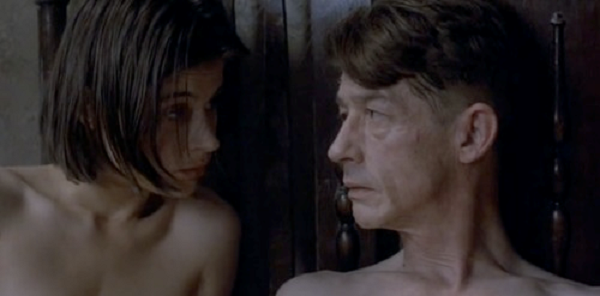
Winston and Julia

Winston's torture
The entire movie felt like a surveillance of Winston, like we were watching him the same way the Party does. It concurred with my conclusion for why the book is written from a third person standpoint. In addition, the element of sound played a significant role in the movie that was hard to grasp from the words in the book. The contrast between the loud riots and total silence created depth and suspense in the movie. However, even during the moments of silence, it felt as though someone's presence was still always there. For this reason, the whole movie left me feeling on edge, expecting the unexpected at any minute, even though I knew what was going to happen from having read the book.
There were some notable differences between the movie and the book, however, they did not detract from the movie. For starters, everyone refers to each other as 'brother' or 'sister', not comrade. This conveys almost a sense of family among people, similar to the connotation 'Big Brother' has, yet is completely ironic in context. The society wants to eradicate the idea of marriage, union, and having children. This idea of lovingness was further developed between O'Brien and Winston, while he was in the process of re-integration. In between physically brutal conditioning sessions, O'Brien would touch Winston's hand or hold him in his arms, as though lovingly nurturing him. Again, I found this to be ironic, and played up more so in the movie than in the book. It served the purpose of showing how the rulers are also trying to take over the role of raising and the malleable children. Overall, the dynamic between governmental officials and their people is quite bizarre.
The last lingering question I have for both the book and the movie is what the significance of chess is? The game was played multiple times in both mediums and I could not determine if there was a symbolic meaning of it. I considered applying it to the idea of victory, of thinking steps ahead into the future, and whether the traditional black and white pieces were a continuation of the contrasting motifs of light and dark. Perhaps I am simply reading too much into this, who knows, or maybe another thought will come to me during a re-read or re-watch someday.

No comments:
Post a Comment