Just to provide some closure with the book, as well as some interesting lingering thoughts, I decide to compile a "follow-up" post. This will contain a few miscellaneous categories such as a few of my favorite quotes, links to articles that make connections between 1984 and today's society, and a letter from George Orwell himself. I hope you have enjoyed the vicarious reading experience through my blog and are eager to read the book for yourself now!
Quotes
"Who controls the past controls the future: who controls the present controls the past"
"Stupidity was as necessary as intelligence and as difficult to attain"
"If he thinks he floats off the floor, and if I simultaneously think I see him do it, then the thing happens."
"Perhaps one did not want to be loved so much as to be understood"
"Perhaps a lunatic was simply a minority of one"
Connections to 2015
This article from CNN, titled, "We're living 1984 today," is worth taking a read. It draws parallels between the National Security Agency and the lack of privacy in the book. Additionally, it pulls key symbols such as telescreens and Newspeak and shows how they are prominent today, but under a different name of course.
George Orwell on 1984
George Orwell wrote this letter before publishing his book. It explains his reasoning for writing as well as gives insights into his predictions for the future. I find it worthwhile to learn the background behind a book, because the context often gives me a new perspective and mindset when revisiting it.
Monday, May 25, 2015

1984: The Movie
After finishing the book, I thought it would be interesting to watch the movie and compare the two. Normally I am not thrilled with the movie versions, either because they cut out major parts of the book or the directors interpret characters or scenes differently than I had. In this case, however, I actually enjoyed the visual enhancement. Here is a link to the trailer to give you a sense of visual perspective. I'm also going to include a few photos from the movie below. Although you haven't yet read the book, I'm sure you have created some images in your mind during the course of reading the blog!


The movie gave a sense of the God-like worship of Big Brother, the barbarianism during the Two Minutes Hate, the intrusive omnipresence of the telescreens, and the sound that constantly bombards the citizens in a way that the book could not convey. I was thoroughly creeped out by the posters and truly felt as though I were immersed in the society.
The entire movie felt like a surveillance of Winston, like we were watching him the same way the Party does. It concurred with my conclusion for why the book is written from a third person standpoint. In addition, the element of sound played a significant role in the movie that was hard to grasp from the words in the book. The contrast between the loud riots and total silence created depth and suspense in the movie. However, even during the moments of silence, it felt as though someone's presence was still always there. For this reason, the whole movie left me feeling on edge, expecting the unexpected at any minute, even though I knew what was going to happen from having read the book.
There were some notable differences between the movie and the book, however, they did not detract from the movie. For starters, everyone refers to each other as 'brother' or 'sister', not comrade. This conveys almost a sense of family among people, similar to the connotation 'Big Brother' has, yet is completely ironic in context. The society wants to eradicate the idea of marriage, union, and having children. This idea of lovingness was further developed between O'Brien and Winston, while he was in the process of re-integration. In between physically brutal conditioning sessions, O'Brien would touch Winston's hand or hold him in his arms, as though lovingly nurturing him. Again, I found this to be ironic, and played up more so in the movie than in the book. It served the purpose of showing how the rulers are also trying to take over the role of raising and the malleable children. Overall, the dynamic between governmental officials and their people is quite bizarre.
The last lingering question I have for both the book and the movie is what the significance of chess is? The game was played multiple times in both mediums and I could not determine if there was a symbolic meaning of it. I considered applying it to the idea of victory, of thinking steps ahead into the future, and whether the traditional black and white pieces were a continuation of the contrasting motifs of light and dark. Perhaps I am simply reading too much into this, who knows, or maybe another thought will come to me during a re-read or re-watch someday.

Big Brother
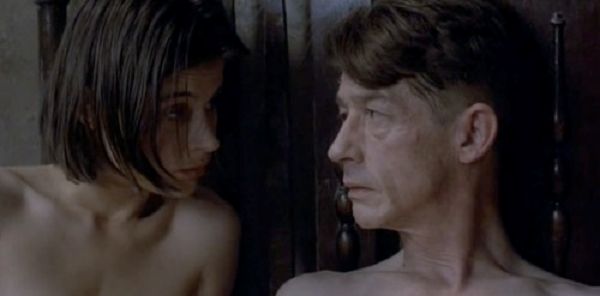
Winston and Julia

Winston's torture
The entire movie felt like a surveillance of Winston, like we were watching him the same way the Party does. It concurred with my conclusion for why the book is written from a third person standpoint. In addition, the element of sound played a significant role in the movie that was hard to grasp from the words in the book. The contrast between the loud riots and total silence created depth and suspense in the movie. However, even during the moments of silence, it felt as though someone's presence was still always there. For this reason, the whole movie left me feeling on edge, expecting the unexpected at any minute, even though I knew what was going to happen from having read the book.
There were some notable differences between the movie and the book, however, they did not detract from the movie. For starters, everyone refers to each other as 'brother' or 'sister', not comrade. This conveys almost a sense of family among people, similar to the connotation 'Big Brother' has, yet is completely ironic in context. The society wants to eradicate the idea of marriage, union, and having children. This idea of lovingness was further developed between O'Brien and Winston, while he was in the process of re-integration. In between physically brutal conditioning sessions, O'Brien would touch Winston's hand or hold him in his arms, as though lovingly nurturing him. Again, I found this to be ironic, and played up more so in the movie than in the book. It served the purpose of showing how the rulers are also trying to take over the role of raising and the malleable children. Overall, the dynamic between governmental officials and their people is quite bizarre.
The last lingering question I have for both the book and the movie is what the significance of chess is? The game was played multiple times in both mediums and I could not determine if there was a symbolic meaning of it. I considered applying it to the idea of victory, of thinking steps ahead into the future, and whether the traditional black and white pieces were a continuation of the contrasting motifs of light and dark. Perhaps I am simply reading too much into this, who knows, or maybe another thought will come to me during a re-read or re-watch someday.
Lessons from Big Brother
As a way of summarizing the main themes of the book, I decided to make a list of the five most important bits of information that Big Brother wants you to know. Essentially, if you reverse what these lessons say, then you will find something useful. That's because everything in this society is practically backwards. Each of these covers a different aspect of the society and leads us to themes about the book as a whole.
1) Two plus two equals five
No, not four. Five. I don't care what the logic in your head tells you after you put two sets of two fingers together. Two and two makes five. Learn it.
2) War maintains social structure
By staying at war, we are essentially at peace, because everything stays orderly and productive. No one has free time to contemplate thoughts of rebellion or ideas of innovation. This is the way it shall remain in order to keep everyone in their proper place.
3) The past can be altered
The past only exists through memories and records. By deleting old records and forgetting certain memories, the past no longer exists. It can be rewritten and changed for the better or worse, depending on what we want it to be or convey.
4) Suffering leads to conformity
Suffering is enough to bring a person to obedience. When in extreme pain, a person's survival instincts kick in and they are willing to do most anything to stay alive. Therefore, in order to control even the most stubborn non-conformists, physical torture is a necessity.
5) Thinking is a crime
Thinking leads to individualism which counter's our very goals. We strive to make sure all people are the same for they are much easier to control when uniform. If anyone commits the crime of thinking they will be punished severely and publicly to make the consequences clear to others as well.
Takeaway
From these we can see how integral violence and mind control are to the society. By making everyone the same, there is no one that has the knowledge or capability to rebel. This becomes cyclical and destroys all hope of the society ever changing. What we can learn from this is to recognize similar patterns in our own society. Is there constant war that people claim is the "answer"? Is there a follow-the-crowd mentality that everyone is blindly following and not bothering to question? These are the questions that 1984 teaches us to ask. We cannot be a society full of gullibile, over-accepting people or else we run the risk of being taken over. We must maintain a sense of love and unity, while still viewing the world with a critical eye. Furthermore, we must use the past as a window to the future, for if we do not learn from our mistakes we are destined to repeat them. Therefore, even though this book seems extreme and far from today's society, it has elements that could become reality if we do not pay attention and stay informed citizens. Take this book as a guide and use it as a warning for the future, so we do not end up under the rule of our own Big Brother.
1) Two plus two equals five
No, not four. Five. I don't care what the logic in your head tells you after you put two sets of two fingers together. Two and two makes five. Learn it.
2) War maintains social structure
By staying at war, we are essentially at peace, because everything stays orderly and productive. No one has free time to contemplate thoughts of rebellion or ideas of innovation. This is the way it shall remain in order to keep everyone in their proper place.
3) The past can be altered
The past only exists through memories and records. By deleting old records and forgetting certain memories, the past no longer exists. It can be rewritten and changed for the better or worse, depending on what we want it to be or convey.
4) Suffering leads to conformity
Suffering is enough to bring a person to obedience. When in extreme pain, a person's survival instincts kick in and they are willing to do most anything to stay alive. Therefore, in order to control even the most stubborn non-conformists, physical torture is a necessity.
5) Thinking is a crime
Thinking leads to individualism which counter's our very goals. We strive to make sure all people are the same for they are much easier to control when uniform. If anyone commits the crime of thinking they will be punished severely and publicly to make the consequences clear to others as well.
Takeaway
From these we can see how integral violence and mind control are to the society. By making everyone the same, there is no one that has the knowledge or capability to rebel. This becomes cyclical and destroys all hope of the society ever changing. What we can learn from this is to recognize similar patterns in our own society. Is there constant war that people claim is the "answer"? Is there a follow-the-crowd mentality that everyone is blindly following and not bothering to question? These are the questions that 1984 teaches us to ask. We cannot be a society full of gullibile, over-accepting people or else we run the risk of being taken over. We must maintain a sense of love and unity, while still viewing the world with a critical eye. Furthermore, we must use the past as a window to the future, for if we do not learn from our mistakes we are destined to repeat them. Therefore, even though this book seems extreme and far from today's society, it has elements that could become reality if we do not pay attention and stay informed citizens. Take this book as a guide and use it as a warning for the future, so we do not end up under the rule of our own Big Brother.
AP Worthy?
What a captivating and thought-provoking book. 1984 had elements of suspense, romance, political and science fiction, all interwoven to make this dystopian novel universally appealing. No doubt it was a great, but does it stand the test of being deemed "AP worthy"? The AP Literature curriculum intends to prepare students to read and analyze more challenging and sophisticated texts, to be able to delve between the lines, and to interpret what the author wants readers to understand. So in order to assume the title of being "AP worthy", a book needs to provide sufficient practice for identifying symbols, motifs, and themes, as well as recognizing allusions and other literary devices. It also needs to be applicable to a variety of open-response prompts that occur at the end of every exam.
1984, a winner of the Prometheus Best Novels Award, is far from being a purely plot-based book. There are subtle allusions as in the rhymes, symbols and motifs such as the paperweight and singing, complex characters like two-faced O'Brien, and messages that stem from both internal and external conflicts. Furthermore, the content of the book remains relevant today. We see pieces of their society in ours and often hear the referenced line "Big Brother is watching you." This book serves as a reminder of what we don't want our world to look like in the future. Therefore, 1984's literary layers and timeless topic make it deserving of being an AP book.
Open Response Prompts
-Big Brother, the omnipresent symbol of the Party
Thesis:
Big Brother seems to be everywhere, yet nowhere at the same time. We only see ever him through his picture on posters, cigarettes, banners, and screens, never in person. Yet, everyone blindly follows this leader of theirs without even questioning his existence. His character serves the purpose of representing the society, in addition to revealing the brainwashed nature of its people.
Support:
-Big Brother controls people's minds and tells them what to think no matter how much it contradicts logic, ex) 2 + 2 =5
-Releases unreliable information and statistics that no one questions, ex) wars, rations, production
-People blindly go along with Hate Week and Two Minutes Hate because Big Brother says to
-Thoughtcrime for not loving Big Brother
-Winston betraying Julia
Thesis:
Betraying Julia is something Winston promises to never do. While talking with O'Brien during their first meeting, he agrees to put himself in harm's way and endure most anything, so long as it does not involve breaking his loyalty to her. That all changes when he is about to have his head submerged in a cage full of rats and pleas to have it done to her instead. This act of betrayal shows the power of society to corrupt its people.
Support:
-O'Brien's initial meeting with Winston vs at the Ministry of Love after arrest
-Winston saying Julia doesn't actually mean that much to him
-O'Brien manipulating him to the point he gives in
-Winston's change in character
-Winston
Thesis:
On the outside Winston appears to live the same as everyone else in the society, however, when he is out of sight of the telescreens and microphones, he expresses his internal questioning of the society. This conflict goes to show how mentally destructive a society is that attempts to totally control its people.
Support:
-Winston writing in diary and thinking freely
-Struggling to see logic in what he's being fed
-Visiting Proles to find out about past; "did it used to be better than it is now?"
-At the Ministry of Love struggling to believe
-The Party
Thesis:
The Party rules Oceania with the principles of Ingsoc. Their power-hungry motivation is purely selfish and all they want is control for the sake of having control over others. Their power struggle demonstrates how people's intentions become corrupt when they act in a selfish manner.
Support:
-Vaporizations to quell rebellion
-People of the Inner Party live luxurious lives, ex) O'Brien's house
-Emmanuel Goldstein's book about Oligarchial Collectivism
-Limit supply keep people impoverished and feed information to keep people uneducated
1984, a winner of the Prometheus Best Novels Award, is far from being a purely plot-based book. There are subtle allusions as in the rhymes, symbols and motifs such as the paperweight and singing, complex characters like two-faced O'Brien, and messages that stem from both internal and external conflicts. Furthermore, the content of the book remains relevant today. We see pieces of their society in ours and often hear the referenced line "Big Brother is watching you." This book serves as a reminder of what we don't want our world to look like in the future. Therefore, 1984's literary layers and timeless topic make it deserving of being an AP book.
Open Response Prompts
1994. In some works of literature, a character who appears briefly, or does not appear at all, is a significant presence. Choose a novel or play of literary merit and write an essay in which you show how such a character functions in the work. You may wish to discuss how the character affects action, theme, or the development of other characters. Avoid plot summary.Character:
-Big Brother, the omnipresent symbol of the Party
Thesis:
Big Brother seems to be everywhere, yet nowhere at the same time. We only see ever him through his picture on posters, cigarettes, banners, and screens, never in person. Yet, everyone blindly follows this leader of theirs without even questioning his existence. His character serves the purpose of representing the society, in addition to revealing the brainwashed nature of its people.
Support:
-Big Brother controls people's minds and tells them what to think no matter how much it contradicts logic, ex) 2 + 2 =5
-Releases unreliable information and statistics that no one questions, ex) wars, rations, production
-People blindly go along with Hate Week and Two Minutes Hate because Big Brother says to
-Thoughtcrime for not loving Big Brother
2007, Form B. Works of literature often depict acts of betrayal. Friends and even family may betray a protagonist; main characters may likewise be guilty of treachery or may betray their own values. Select a novel or play that includes such acts of betrayal. Then, in a well-written essay, analyze the nature of the betrayal and show how it contributes to the meaning of the work as a whole.Betrayal:
-Winston betraying Julia
Thesis:
Betraying Julia is something Winston promises to never do. While talking with O'Brien during their first meeting, he agrees to put himself in harm's way and endure most anything, so long as it does not involve breaking his loyalty to her. That all changes when he is about to have his head submerged in a cage full of rats and pleas to have it done to her instead. This act of betrayal shows the power of society to corrupt its people.
Support:
-O'Brien's initial meeting with Winston vs at the Ministry of Love after arrest
-Winston saying Julia doesn't actually mean that much to him
-O'Brien manipulating him to the point he gives in
-Winston's change in character
2005. In Kate Chopin’s The Awakening (1899), protagonist Edna Pontellier is said to possess “That outward existence which conforms, the inward life that questions.” In a novel or play that you have studied, identify a character who outwardly conforms while questioning inwardly. Then write an essay in which you analyze how this tension between outward conformity and inward questioning contributes to the meaning of the work. Avoid mere plot summary.Character:
-Winston
Thesis:
On the outside Winston appears to live the same as everyone else in the society, however, when he is out of sight of the telescreens and microphones, he expresses his internal questioning of the society. This conflict goes to show how mentally destructive a society is that attempts to totally control its people.
Support:
-Winston writing in diary and thinking freely
-Struggling to see logic in what he's being fed
-Visiting Proles to find out about past; "did it used to be better than it is now?"
-At the Ministry of Love struggling to believe
2005, Form B. One of the strongest human drives seems to be a desire for power. Write an essay in which you discuss how a character in a novel or a drama struggles to free himself or herself from the power of others or seeks to gain power over others. Be sure to demonstrate in your essay how the author uses this power struggle to enhance the meaning of the work.Character:
-The Party
Thesis:
The Party rules Oceania with the principles of Ingsoc. Their power-hungry motivation is purely selfish and all they want is control for the sake of having control over others. Their power struggle demonstrates how people's intentions become corrupt when they act in a selfish manner.
Support:
-Vaporizations to quell rebellion
-People of the Inner Party live luxurious lives, ex) O'Brien's house
-Emmanuel Goldstein's book about Oligarchial Collectivism
-Limit supply keep people impoverished and feed information to keep people uneducated
Big Brother Forever
Imagine yourself in a room, where overhead lights constantly beat down on you, day and night. There are no windows and you have no conception of time. If you make the slightest wrong movement, the telescreen will bark orders at you, commanding you to assume a standard position. The people around you wear expressions of fear, of hatred, of denial. You are all in the room for the same reason: crime against the Party. Hunger begins to gnaw at your stomach, and your main priority becomes instinctively to stay alive as those around begin to disappear one by one to a mysterious Room 101.
These are the circumstances Winston faces in the Ministry of Love following his arrest. All hope he has for the future vanishes and any trust in O'Brien ceases, for he is the man behind the whole set up. For seven years, O'Brien had spied on Winston, waiting for the perfect time to turn him in. After doing just that, he puts Winston through intense physical beatings and mind manipulation, all in effort to conform his brain before either shooting him or setting him free.
Winston defies at first, but eventually gives up during the second and third stages of his "reintegration process," understanding and accepting. After all, isn't it much easier to just conform- to love Big Brother and accept their logic, no matter how much it goes against every thought in your mind? He now believes two and two actually make five. He believes the history the Party feeds him is true. He believes doublethink is natural. During this process, he even betrays Julia in effort to save himself in Room 101 from his worst nightmare: a cage of rats eager to eat his face off. Needless to say, the Party succeeds in the end. They corrupt his mind and take control over him the way they do with everyone else.
Big Brother forever. The End.
These are the circumstances Winston faces in the Ministry of Love following his arrest. All hope he has for the future vanishes and any trust in O'Brien ceases, for he is the man behind the whole set up. For seven years, O'Brien had spied on Winston, waiting for the perfect time to turn him in. After doing just that, he puts Winston through intense physical beatings and mind manipulation, all in effort to conform his brain before either shooting him or setting him free.
Winston defies at first, but eventually gives up during the second and third stages of his "reintegration process," understanding and accepting. After all, isn't it much easier to just conform- to love Big Brother and accept their logic, no matter how much it goes against every thought in your mind? He now believes two and two actually make five. He believes the history the Party feeds him is true. He believes doublethink is natural. During this process, he even betrays Julia in effort to save himself in Room 101 from his worst nightmare: a cage of rats eager to eat his face off. Needless to say, the Party succeeds in the end. They corrupt his mind and take control over him the way they do with everyone else.
Big Brother forever. The End.
Sunday, May 24, 2015
Part II: secrets and spoilers
As I write this, I am still processing all that has just occurred- plot twists, new characters, and more explanations. This post will re-cap Part II as well as further develop some of the symbols, themes, and characters from the Part I post. (*Fair warning, as indicated by the title, there are going to be spoilers. It would be impossible to analyze this section without giving the story away.)
Let's jump right in and begin with O'Brien, a man who we now know to be a member of the Brotherhood disguised as a member of the Inner Party. His character serves as a representative of this counter-movement, a person with inside-access who would never be suspected of disobeying. He plays the game of the Party intelligently, and is therefore able to outsmart it. O'Brien inspires Winston and passes on his knowledge in the form of a book by the one and only Emmanuel Goldstein titled "The Theory and Practice of Oligarchial Collectvism." It provides a window to the past in how the world did not always used to be like this. Starvation didn't prevail, war did not constantly take place, and people were not always conditioned to not think. It also ties the current state of the society to its famous slogan "Ignorance is Strength, Freedom is Slavery, War is Peace."
The book provides an explanation for how the society keeps its people ignorant by teaching them what to think and what words to think with. This essentially leaves no room for creativity or discovery or invention, which is what advancement depends on. Anyone who does not conform to this mentality gets killed off, which sends out a message to others about what will happen if they do the same. The book also provides an explanation for the line about war being peace. Goldstein starts with how the Party tries to keep everyone working all the time. In doing so, people have less time on their hands to think about revolution, and are instead being productive members of the Party. To use up this surplus of goods, which the Party would never dream of giving to people because it wants everyone to be impoverished to some degree, it stays in a constant state of war. However, the war is not really a war, because each of the three super-states that fight each other are self-sufficient and stable politically and economically. Therefore, it is more of a game that keeps everyone in a constant state of fear, poverty, and governmental dependence, and in turn maintains the societal structure and strength. The only problems the super-state must constantly strive to solve are "how to discover, against his will, what another human being is thinking, and how to kill several hundred million people in a few seconds without giving warning beforehand" (201). Pretty twisted, right? Well, that sums up the society as a whole. We are left with a good picture of how this society operates, yet, as Winston puts it, we are still unsure of why.
Additionally, Goldstein provides some insights that tie up loose ends from the last section. First of all, he clues in Winston to how the rhyme ends.
Another interesting component of this section is the continuation of the contrast between light and dark. At one point, Winston says how they are fighting in the dark, meaning they are blind to what the outcome will be in the future. The most notable scene that features this contrast is when Winston says to O'Brien that they should meet again "in the place where there is no darkness" (185). This is actually foreshadowed earlier in the book during one of Winston's dreams. It is an ironic reference to the Ministry of Love, because they always have lights on and are supposed to concern themselves with love, but actually concern themselves with torturing people. The darkness continues to represent uncertainty, fear, and hatred, but light is now also negatively associated with torture and pain, instead of representing freedom, peace, and hope. Light and dark seem to intertwine in the book, symbolizing the inability people in the society have to distinguish wrong from right and truth from falsehood. It gives readers less hope for the society's future.
Singing is another motif worth pointing out. People, especially the Proles who follow the unconsciously follow the party, sing almost constantly. I guarantee that half the people don't even know what they are singing about, though. It is a way for them to communicate still and reminds me almost of a historical reference to slaves singing in fields. The Proles are comparable to slaves in the society and their singing is a pleasant way for them to communicate. After all, you don't see members of the Inner Party walking around singing. In addition, singing is seen through the bird that whistles during Julia and Winston's first meeting in the woods. That, too, symbolizes the recognition of their societal defiance and freedom and, ultimately, hope.
Okay, now I think I have covered most of it- O'Brien and the Brotherhood, Emmanuel Goldstein's book, the mysterious rhyme, and singing and light/dark motifs. To wrap this up, I will leave you hanging on the same cliff hanger I am on. Prepare yourself for this! Julia and Winston just got caught. They are surrounded by men, voices are telling them to put their hands up, and Mr. Charrington's true identity as a member of the Thought Police just got revealed. Part III is about to get interesting, so check back soon to see what becomes of this situation as the book comes to a close.
Let's jump right in and begin with O'Brien, a man who we now know to be a member of the Brotherhood disguised as a member of the Inner Party. His character serves as a representative of this counter-movement, a person with inside-access who would never be suspected of disobeying. He plays the game of the Party intelligently, and is therefore able to outsmart it. O'Brien inspires Winston and passes on his knowledge in the form of a book by the one and only Emmanuel Goldstein titled "The Theory and Practice of Oligarchial Collectvism." It provides a window to the past in how the world did not always used to be like this. Starvation didn't prevail, war did not constantly take place, and people were not always conditioned to not think. It also ties the current state of the society to its famous slogan "Ignorance is Strength, Freedom is Slavery, War is Peace."
The book provides an explanation for how the society keeps its people ignorant by teaching them what to think and what words to think with. This essentially leaves no room for creativity or discovery or invention, which is what advancement depends on. Anyone who does not conform to this mentality gets killed off, which sends out a message to others about what will happen if they do the same. The book also provides an explanation for the line about war being peace. Goldstein starts with how the Party tries to keep everyone working all the time. In doing so, people have less time on their hands to think about revolution, and are instead being productive members of the Party. To use up this surplus of goods, which the Party would never dream of giving to people because it wants everyone to be impoverished to some degree, it stays in a constant state of war. However, the war is not really a war, because each of the three super-states that fight each other are self-sufficient and stable politically and economically. Therefore, it is more of a game that keeps everyone in a constant state of fear, poverty, and governmental dependence, and in turn maintains the societal structure and strength. The only problems the super-state must constantly strive to solve are "how to discover, against his will, what another human being is thinking, and how to kill several hundred million people in a few seconds without giving warning beforehand" (201). Pretty twisted, right? Well, that sums up the society as a whole. We are left with a good picture of how this society operates, yet, as Winston puts it, we are still unsure of why.
Additionally, Goldstein provides some insights that tie up loose ends from the last section. First of all, he clues in Winston to how the rhyme ends.
" 'Oranges and lemons,' say the bells of St Clement's,That last line instantly shows why the Party does not want anyone to have any recollection of the the latter half. The idea of 'growing rich' is something that the Party does not want implemented in any of its followers' minds. The Party strives to keep everyone in their own low-middle classes and not have any economic mobility for this connotes thinking for themselves and finding a way to increase their status. Overall, the main purpose of including this rhyme in the book is to show the society's repressive nature and to also provide a connection to the past through the allusions to the churches.
'You owe me three farthings,' say the bells of St Martin's,
'When will you pay me?' say the bells of Old Bailey,
'When I grow rich,' say the bells of Shoreditch." (186)
Another interesting component of this section is the continuation of the contrast between light and dark. At one point, Winston says how they are fighting in the dark, meaning they are blind to what the outcome will be in the future. The most notable scene that features this contrast is when Winston says to O'Brien that they should meet again "in the place where there is no darkness" (185). This is actually foreshadowed earlier in the book during one of Winston's dreams. It is an ironic reference to the Ministry of Love, because they always have lights on and are supposed to concern themselves with love, but actually concern themselves with torturing people. The darkness continues to represent uncertainty, fear, and hatred, but light is now also negatively associated with torture and pain, instead of representing freedom, peace, and hope. Light and dark seem to intertwine in the book, symbolizing the inability people in the society have to distinguish wrong from right and truth from falsehood. It gives readers less hope for the society's future.
Singing is another motif worth pointing out. People, especially the Proles who follow the unconsciously follow the party, sing almost constantly. I guarantee that half the people don't even know what they are singing about, though. It is a way for them to communicate still and reminds me almost of a historical reference to slaves singing in fields. The Proles are comparable to slaves in the society and their singing is a pleasant way for them to communicate. After all, you don't see members of the Inner Party walking around singing. In addition, singing is seen through the bird that whistles during Julia and Winston's first meeting in the woods. That, too, symbolizes the recognition of their societal defiance and freedom and, ultimately, hope.
Okay, now I think I have covered most of it- O'Brien and the Brotherhood, Emmanuel Goldstein's book, the mysterious rhyme, and singing and light/dark motifs. To wrap this up, I will leave you hanging on the same cliff hanger I am on. Prepare yourself for this! Julia and Winston just got caught. They are surrounded by men, voices are telling them to put their hands up, and Mr. Charrington's true identity as a member of the Thought Police just got revealed. Part III is about to get interesting, so check back soon to see what becomes of this situation as the book comes to a close.
Saturday, May 23, 2015
Questions, Answered
I am a little over the half-way point and am finally starting to get some answers to my questions. I wouldn't go so far as to say the books is tying up loose ends, but it is definitely revealing a bit more.
Who is this mysterious, dark-haired girl?
Her name is Julia, and she is a rebellious 26 year-old who pretends to conform to the society by participating in the Junior Anti-Sex League and performing her duties at the Fiction Department. Oh, and she is in love with Winston. Yes, that last bit is true, believe it or not. She slipped him a note one day after he helped her up from a fall that read "I love you" (113). Before this occurrence, they had only laid eyes on each other once or twice, let alone spoken a full conversation. Her confession marked a dramatic shift in the story and now she has become an integral character. She and Winston are always planning secret meetings, trying to communicate without being caught by the telescreens, and experimenting with the desires they are deprived of. Winston says how "she ha[s] become a physical necessity, something that he not only wanted but felt that he had a right to" (146). They kiss and have sex multiple times, always feeling "their embrace had been a battle, the climax a victory...a blow struck against the Party...a political act" (133). By allowing themselves to acknowledge their lust and do something that the society discourages, they feel they are sparking change in a sense. As Julia puts it:
Why is the book written from a third person perspective?
At first, I struggled to find meaning in this stylistic choice. It found it strange that this book does not utilize first person from Winston's perspective. Then, in the last 20 pages or so, a possible explanation hit me: reading this book feels as though we, as readers, are spying on Winston. The detached yet close standpoint creates a sense of invading the privacy of Winston's life. Doesn't this sound familiar? This is exactly what the telescreens do, they spy on Winston and get a very good sense of what is going on, yet they are not fully submerged in his life because he manages to escape them at points. Therefore, the style of the book mirrors the happenings in the society regarding surveillance.
What is up with his ulcer?
This ulcer is a varicose ulcer located on his ankle that frequently itches. I tried to look for connections between time of day, certain events, and other indicators that would give me a better sense of its meaning. However, since he has been meeting with Julia, it hasn't been mentioned, so my search for clues has come to a halt. Interestingly, I decided to use this itself as a clue. Itches are something that need to be scratched, an annoying sensation that requires immediate attention. When he's with Julia, he is practically in a state of release, not holding feelings inside and wanting desperately to rebel. Therefore, perhaps his ulcer is symbolic of his emotions while under control of the Party.
What do the rhymes mean?
The most prominent rhyme starts, "'Oranges and lemons,' say the bells of St Clement's, 'You owe my three farthing,' say the bells of St Martin's-" (102). However, no one seems to remember the middle. After searching this rhyme on the Internet, I have come to learn it is an English nursery rhyme that contains an allusion to the Great Fire of London in 1666, which destroyed a famous church. I am still unsure of the connection, but I do know that oranges and lemons are not prevalent in Airstrip One. Hopefully the coming sections give more indication of its deeper meaning.
What is the significance of the glass paperweight?
Winston bought the glass paperweight with a coral center at Mr. Charrington's shop, the same place where he bought his diary. "The inexhaustibly interesting thing was not the fragment of coral but the interior of the glass itself. There was such a depth of it, and yet it was almost transparent as air. It was as though the surface of the glass had been the arch of the sky, enclosing a tiny world with its atmosphere complete. [Winston] had the feeling that he could get inside it, and that in fact he was inside it, along with the mahogany bed and the gate-leg table, and the clock and the steel engraving and the paperweight itself. The paperweight was the room he was in, and the coral was Julia's life and his own, fixed in sort of eternity at the heart of the crystal" (154). Aside from loving the way this passage is written, I found it provided an immense amount of insight into this small, yet symbolic token. It shows the emotional growth Winston has experienced, and the budding relationship between him and Julia.
How did this society come to existence?
"The story really began in the middle 'sixties, the period of the great purges in which the original leaders of the Revolution were wiped out once and for all. By 1970 none of them was left, except Big Brother himself. All the rest had by that time been exposed as traitors or counter-revolutionaries" (78). So there is the big answer, or at least part of it. War, and presumably the turmoil that came with it, left everyone in search of leadership to assuage their fears and promise restoration and order. Big Brother seemed like a hopeful option, and so his reign began. From there, the society only went downhill. This isn't the first time we have heard of a story like this. It reminds me of Germany during the time of the NAZI's after Hitler came to power. He provided everyone a glimmer of hope at mending the economic state and lingering devastation from World War I. Little did everyone know that his sole intent was to take advantage of and manipulate them just like Big Brother. Interestingly, this book was written in 1949 and Hitler came to power in 1933. Connection? I think so.
Who is this mysterious, dark-haired girl?
Her name is Julia, and she is a rebellious 26 year-old who pretends to conform to the society by participating in the Junior Anti-Sex League and performing her duties at the Fiction Department. Oh, and she is in love with Winston. Yes, that last bit is true, believe it or not. She slipped him a note one day after he helped her up from a fall that read "I love you" (113). Before this occurrence, they had only laid eyes on each other once or twice, let alone spoken a full conversation. Her confession marked a dramatic shift in the story and now she has become an integral character. She and Winston are always planning secret meetings, trying to communicate without being caught by the telescreens, and experimenting with the desires they are deprived of. Winston says how "she ha[s] become a physical necessity, something that he not only wanted but felt that he had a right to" (146). They kiss and have sex multiple times, always feeling "their embrace had been a battle, the climax a victory...a blow struck against the Party...a political act" (133). By allowing themselves to acknowledge their lust and do something that the society discourages, they feel they are sparking change in a sense. As Julia puts it:
"When you make love your're using up energy; and afterwards you feel happy and don't give a damn for anything. they can't bear to feel like that. They want you to be bursting with energy all the time. All this marching up and down and cheering and waving flags is simply sex gone sour. If you're happy inside yourself, why should you get excited about Big Brother and the Three-Year Plans and the Two Minutes Hate and all the rest of their bloody rot?" (139)Julia further draws out Winston's desire to rebel and sparks greater development. He now feels comfortable sneaking out of town on some unknown route to meet up with her and then enjoying the forbidden goods such as coffee, sugar, and chocolate that she has presumably stolen from the Inner Party. I am eager to find out what becomes of their relationship, because I predict they will get caught at some point.
Why is the book written from a third person perspective?
At first, I struggled to find meaning in this stylistic choice. It found it strange that this book does not utilize first person from Winston's perspective. Then, in the last 20 pages or so, a possible explanation hit me: reading this book feels as though we, as readers, are spying on Winston. The detached yet close standpoint creates a sense of invading the privacy of Winston's life. Doesn't this sound familiar? This is exactly what the telescreens do, they spy on Winston and get a very good sense of what is going on, yet they are not fully submerged in his life because he manages to escape them at points. Therefore, the style of the book mirrors the happenings in the society regarding surveillance.
What is up with his ulcer?
This ulcer is a varicose ulcer located on his ankle that frequently itches. I tried to look for connections between time of day, certain events, and other indicators that would give me a better sense of its meaning. However, since he has been meeting with Julia, it hasn't been mentioned, so my search for clues has come to a halt. Interestingly, I decided to use this itself as a clue. Itches are something that need to be scratched, an annoying sensation that requires immediate attention. When he's with Julia, he is practically in a state of release, not holding feelings inside and wanting desperately to rebel. Therefore, perhaps his ulcer is symbolic of his emotions while under control of the Party.
What do the rhymes mean?
The most prominent rhyme starts, "'Oranges and lemons,' say the bells of St Clement's, 'You owe my three farthing,' say the bells of St Martin's-" (102). However, no one seems to remember the middle. After searching this rhyme on the Internet, I have come to learn it is an English nursery rhyme that contains an allusion to the Great Fire of London in 1666, which destroyed a famous church. I am still unsure of the connection, but I do know that oranges and lemons are not prevalent in Airstrip One. Hopefully the coming sections give more indication of its deeper meaning.
What is the significance of the glass paperweight?
Winston bought the glass paperweight with a coral center at Mr. Charrington's shop, the same place where he bought his diary. "The inexhaustibly interesting thing was not the fragment of coral but the interior of the glass itself. There was such a depth of it, and yet it was almost transparent as air. It was as though the surface of the glass had been the arch of the sky, enclosing a tiny world with its atmosphere complete. [Winston] had the feeling that he could get inside it, and that in fact he was inside it, along with the mahogany bed and the gate-leg table, and the clock and the steel engraving and the paperweight itself. The paperweight was the room he was in, and the coral was Julia's life and his own, fixed in sort of eternity at the heart of the crystal" (154). Aside from loving the way this passage is written, I found it provided an immense amount of insight into this small, yet symbolic token. It shows the emotional growth Winston has experienced, and the budding relationship between him and Julia.
How did this society come to existence?
"The story really began in the middle 'sixties, the period of the great purges in which the original leaders of the Revolution were wiped out once and for all. By 1970 none of them was left, except Big Brother himself. All the rest had by that time been exposed as traitors or counter-revolutionaries" (78). So there is the big answer, or at least part of it. War, and presumably the turmoil that came with it, left everyone in search of leadership to assuage their fears and promise restoration and order. Big Brother seemed like a hopeful option, and so his reign began. From there, the society only went downhill. This isn't the first time we have heard of a story like this. It reminds me of Germany during the time of the NAZI's after Hitler came to power. He provided everyone a glimmer of hope at mending the economic state and lingering devastation from World War I. Little did everyone know that his sole intent was to take advantage of and manipulate them just like Big Brother. Interestingly, this book was written in 1949 and Hitler came to power in 1933. Connection? I think so.
Friday, May 22, 2015
Dystopic Connections
While reading 1984, I found myself reminded of a couple other novels I've read this past year- The Handmaid's Tale by Margaret Atwood and Brave New World by Aldous Huxley. All are based on corrupt societies, both politically and socially, and have various characteristics in common. They overlap on everything from political ideals and class divisions to views on sex and propaganda. In order to illustrate these connections, as well as further develop my explanation of the society depicted in 1984, I decided a comparison/contrast post would be interesting.
To start us off, here are brief synopses of The Handmaid's Tale and Brave New World, courtesy of Goodreads:
The Handmaid's Tale
Connections to...
The Handmaid's Tale
1) The protagonists in both novels use writing and language as a means to gain a sense of control. Offred, a handmaid used solely for reproduction in Gilead, lives under the control of her master. Most of her freedom has been taken away, but what Gilead can't take away from her is her love for language and words' meanings that give her a sense of empowerment. Being able to think what she wants and use words to convey what she wants to, Offred maintains a sense of sanity. Similarly, Winston uses writing in his diary as a way to have a sense of control in a world where most of his freedom is gone. By expressing his skepticism of the society and questioning their use of language, he ultimately is able to rebel against the Party.
2) Both the societies of Gilead and Airstrip One discourage personal connections, especially during sexual interactions. In Gilead, sex is to be a detached ritual solely to produce children. To make it all the more awkward, it occurs between husband and wife and handmaid. Needless to say, the emotional attachment and pleasure is nonexistent and that is exactly how the rulers want it. The ruling Party of Airstrip One similarly tries to keep its people from forming personal connections. Sex is to be limited significantly, if occur at all. The Junior Anti-Sex League is a prominent group that advocates for celibacy, though Winston does describe a sexual encounter at one point. He recalls how "she would lie there with shut eyes, neither resisting nor co-operating, but submitting" and call it "[their] duty to the party" (70). This shows the desensitization both he and the woman feel as opposed to acknowledging their emotions during the experience which is the natural human reaction. The goal in wanting people to suppress their emotions and feelings is to discourage unity which could lead to rebellion.
Another way both novels use sex is to convey male dominance. The Masters, as Gilead refers to them, usually have sex with multiple handmaid's throughout their lives (not to mention the women at Jezebel's) and they take control the whole time. In 1984, the men known as Capitalists are positioned on a similar hierarchy level. They "[have] the right to sleep with any woman working in one of [their] factories" (76).
3) In both novels, rituals take place that involve execution. There is a wall of people in Gilead who have been hanged. It is a public display that serves as a daily reminder to obey the society. In Airstrip One there are hangings that take place frequently. People of all ages, even small children, get excited to go and see the supposed "rule breakers" get killed. Beneath the excitement, however, lies sheer fear, fear of breaking the rules and becoming one of those to get hanged themselves. This fear tactic is a method that both ruling classes use to keep their people in line.
Brave New World
1) Conditioning is an integral part to both societies. It is an effective way to be sure that all people think, act, and respond in a manner that has been "approved" by the rulers. Conditioning practices in the World State include hypnopaedia, messages induced during sleep, and repetitive exposure and punishment. The Party uses similar methods of "early conditioning, by games and cold water, by the rubbish that was dinned into them at school and in the Spies and the Youth League, by lectures, parades, songs, slogans and martial music" (71) to instill their ideals.
The problem that the main characters of both novels, John and Winston, face is dual-conditioning. John's dual-conditioning comes from living his life on the conservative Reservation and then going to the World State where recreational sex is encouraged. Winston does not experience dual-conditioning directly, however, he recognizes the game the Party is trying to play. In a way, by seeing through the subconscious conditioning, he experiences dual-conditioning. He knows how he should behave and think, yet he is conflicted with how he wants to behave and think. Going back to John, in the end, the dual-conditioning tears him apart and he commits suicide. I'm not predicting Winston will go this far, however, it gives me perspective that having his eyes wide-open may not be the best thing.
2) Propaganda in the form of catchy slogans are also popular in both societies. In the World State, people often go around repeating "community, identity, and stability," which we know to be rather ironic. In Airstrip One, the people say "war is peace, freedom is slavery, ignorance is strength" (107). Again, we recognize this slogan to be paradoxical, yet the citizens are too brainwashed to notice. These are the two main sayings, however, there are also many more. Unfortunately, these catchy phrases become so routine and automatic that they eventually lose their meaning.
3) Advanced technology for sexual reproduction is another similarity between the two. In Brave New World it is referred to as the Bokanovsky process, which is essentially mass-producing test tube babies. Babies are decanted in a hatchery and are pre-assigned to a social class characterized by a specific uniform. In 1984, the Junior Anti-Sex League advocates for the process of creating laboratory babies, called artificial insemination (artsem in Newspeak). Children, once "begotten", are brought up in "public institutions". While this is not as strict as Brave New World, in that they are not immediately assigned to a class, they will eventually be locked into one and forced to wear a corresponding uniform as well. Once again, this control over sexual reproduction is solely for the purpose of the ruling class obtaining as much control as possible.
To start us off, here are brief synopses of The Handmaid's Tale and Brave New World, courtesy of Goodreads:
The Handmaid's Tale
"Offred is a Handmaid in the Republic of Gilead. She may leave the home of the Commander and his wife once a day to walk to food markets whose signs are now pictures instead of words because women are no longer allowed to read. She must lie on her back once a month and pray that the Commander makes her pregnant, because in an age of declining births, Offred and the other Handmaids are valued only if their ovaries are viable. Offred can remember the years before, when she lived and made love with her husband, Luke; when she played with and protected her daughter; when she had a job, money of her own, and access to knowledge. But all of that is gone now... "Brave New World
"Far in the future, the World Controllers have created the ideal society. Through clever use of genetic engineering, brainwashing and recreational sex and drugs, all its members are happy consumers. Bernard Marx seems alone harbouring an ill-defined longing to break free. A visit to one of the few remaining Savage Reservations, where the old, imperfect life still continues, may be the cure for his distress..."
Connections to...
The Handmaid's Tale
1) The protagonists in both novels use writing and language as a means to gain a sense of control. Offred, a handmaid used solely for reproduction in Gilead, lives under the control of her master. Most of her freedom has been taken away, but what Gilead can't take away from her is her love for language and words' meanings that give her a sense of empowerment. Being able to think what she wants and use words to convey what she wants to, Offred maintains a sense of sanity. Similarly, Winston uses writing in his diary as a way to have a sense of control in a world where most of his freedom is gone. By expressing his skepticism of the society and questioning their use of language, he ultimately is able to rebel against the Party.
2) Both the societies of Gilead and Airstrip One discourage personal connections, especially during sexual interactions. In Gilead, sex is to be a detached ritual solely to produce children. To make it all the more awkward, it occurs between husband and wife and handmaid. Needless to say, the emotional attachment and pleasure is nonexistent and that is exactly how the rulers want it. The ruling Party of Airstrip One similarly tries to keep its people from forming personal connections. Sex is to be limited significantly, if occur at all. The Junior Anti-Sex League is a prominent group that advocates for celibacy, though Winston does describe a sexual encounter at one point. He recalls how "she would lie there with shut eyes, neither resisting nor co-operating, but submitting" and call it "[their] duty to the party" (70). This shows the desensitization both he and the woman feel as opposed to acknowledging their emotions during the experience which is the natural human reaction. The goal in wanting people to suppress their emotions and feelings is to discourage unity which could lead to rebellion.
Another way both novels use sex is to convey male dominance. The Masters, as Gilead refers to them, usually have sex with multiple handmaid's throughout their lives (not to mention the women at Jezebel's) and they take control the whole time. In 1984, the men known as Capitalists are positioned on a similar hierarchy level. They "[have] the right to sleep with any woman working in one of [their] factories" (76).
3) In both novels, rituals take place that involve execution. There is a wall of people in Gilead who have been hanged. It is a public display that serves as a daily reminder to obey the society. In Airstrip One there are hangings that take place frequently. People of all ages, even small children, get excited to go and see the supposed "rule breakers" get killed. Beneath the excitement, however, lies sheer fear, fear of breaking the rules and becoming one of those to get hanged themselves. This fear tactic is a method that both ruling classes use to keep their people in line.
Brave New World
1) Conditioning is an integral part to both societies. It is an effective way to be sure that all people think, act, and respond in a manner that has been "approved" by the rulers. Conditioning practices in the World State include hypnopaedia, messages induced during sleep, and repetitive exposure and punishment. The Party uses similar methods of "early conditioning, by games and cold water, by the rubbish that was dinned into them at school and in the Spies and the Youth League, by lectures, parades, songs, slogans and martial music" (71) to instill their ideals.
The problem that the main characters of both novels, John and Winston, face is dual-conditioning. John's dual-conditioning comes from living his life on the conservative Reservation and then going to the World State where recreational sex is encouraged. Winston does not experience dual-conditioning directly, however, he recognizes the game the Party is trying to play. In a way, by seeing through the subconscious conditioning, he experiences dual-conditioning. He knows how he should behave and think, yet he is conflicted with how he wants to behave and think. Going back to John, in the end, the dual-conditioning tears him apart and he commits suicide. I'm not predicting Winston will go this far, however, it gives me perspective that having his eyes wide-open may not be the best thing.
2) Propaganda in the form of catchy slogans are also popular in both societies. In the World State, people often go around repeating "community, identity, and stability," which we know to be rather ironic. In Airstrip One, the people say "war is peace, freedom is slavery, ignorance is strength" (107). Again, we recognize this slogan to be paradoxical, yet the citizens are too brainwashed to notice. These are the two main sayings, however, there are also many more. Unfortunately, these catchy phrases become so routine and automatic that they eventually lose their meaning.
3) Advanced technology for sexual reproduction is another similarity between the two. In Brave New World it is referred to as the Bokanovsky process, which is essentially mass-producing test tube babies. Babies are decanted in a hatchery and are pre-assigned to a social class characterized by a specific uniform. In 1984, the Junior Anti-Sex League advocates for the process of creating laboratory babies, called artificial insemination (artsem in Newspeak). Children, once "begotten", are brought up in "public institutions". While this is not as strict as Brave New World, in that they are not immediately assigned to a class, they will eventually be locked into one and forced to wear a corresponding uniform as well. Once again, this control over sexual reproduction is solely for the purpose of the ruling class obtaining as much control as possible.
Part 1
I recently finished Part I of the book and now look forward to giving you a quick plot update as well as a more in-depth look at the society and the main character, Winston. The majority of Part I served as an introduction. It encompassed descriptions of the setting, the ideals of the Party, and the thoughts of the protagonist. Instead of being driven by the plot through Winston's actions, the book is propelled by his thoughts, growth and sense of awakening. So far, Winston has done little other than buy a journal from a bookstore, sit at home, and go to the part of Airstrip One where the Proles live. The bulk of the novel revolves around what is taking place in his mind during these mundane events. Winston is learning that the Party may not have evidence for the statistics and facts they try to indoctrinate their follows with. He states, "it [is] like a single equation with two unknowns. It might very well be that literally every word in the history books, even the things that one accepted without question, was pure fantasy" (78). This shows how Winston is become more aware and less accepting of what is going on around him. Furthermore, Winston begins to question if the world always was how it is now. During one scene, he asks himself, "had it always been like this? Had food always tasted like this?" and during another he questions whether life was "better before the revolution than it is now?" This consideration of the past is something not many other characters do in this society- either they are too young to remember the past or they cannot recall old memories as though their recollections have been strangely erased. This is exactly what happened when Winston visited the Proles in search of answers to his questions. They gave him generic answers and skirted around the actual questions. Still, Winston's persistence and curiosity is evident through how he now asks questions constantly. As the novel progresses, I'm sure his consciousness will only continue to strengthen.
Winston has also demonstrated growth since the beginning of the novel through his writing. Buying a journal was his first baby step and now he writes full sentences, pages even. He has begun to crave writing as though the pen in his hand provides him the ultimate freedom that the Party denies him of. It is his therapy to be able to write "I understand HOW: I do not understand WHY" (83) and "Freedom is the freedom to say two plus two makes four. If that is granted, all else follows" (84). The power of writing has become his way of expressing himself and gaining control. He must still do so in secret without the telescreen watching, but it is worth it for him. This recurrence of writing touches upon a couple themes developing in the book. First, writing provides a sense of control to people who have had personal freedoms taken away. Thoughts and emotions are powerful tools that people will always have, even when all else feels lost. By being able to express these through writing, people have the ability to maintain their sanity to some degree, seeing as it provides a therapeutic release. Second, attempting to strictly control other people only leads to corruption and rebellion. As we have seen with Winston and other characters such as O'Brien and the Brotherhood, rebellion is brewing even though the Party is doing everything in their power to try and suppress it. The Party's vaporizations and hangings may only be able to scare people for so long before they have had enough. The ending of the book, whether an organized rebellion sparks or not, will give a better indication of this theme in relation to the book.
A final device I want to note is the contrast between light and dark that occurs repeatedly in this section. Light is often associated with hope and the possibilities of the future. Winston writes in his diary one night about a dream he had where there is a woman in the light of a lamp. He wants to have sex with her, which would be breaking societal rules, but he doesn't care, he wants to do it anyways. In this society, sexual interactions that also have an emotional connection is discouraged. The Party does not want unions and partnerships to form for fear of rebellion arising. The lamp light surrounding this woman represents rebellion with a positive connotation. It shows how this society attempts to suppress the human desire for intimacy, but Winston longs to defy it. In contrast, darkness is used in association with the Party, the clothing of the hated Capitalists, and the hair of the woman who Winston thinks is a spy for the Thought Police. The darkness, as depicted through these, negatively represents the current state of the society and how blinding it is. No one can separate truth from falsehood and everyone mindlessly follows the leadership of Big Brother without question. Ultimately, this contrast serves the purpose of reflecting the internal conflict within Winston. He wants to rebel and go towards the light, yet at the same time, the darkness tempts him and seems safer because the majority lives their lives in it.
As I begin Part II of the book, I will keep this analysis of Part I in mind and continue to trace the development of these characters, themes, and motifs. In addition, I will be searching for the answers to the questions I have and explanations for some of the strange occurrences. In particular, I am curious about this itch and this ulcer that Winston has. It seems every other page he is ailing physically, and I wonder what their significance is to the story. Also, there are these rhymes interspersed throughout the story, one about oranges, lemons, and St. Clement, and another about lying under a chestnut tree. Are they subliminal message of propaganda? Do they have a decipherable meaning? I'm off to keep reading and find out.
Winston has also demonstrated growth since the beginning of the novel through his writing. Buying a journal was his first baby step and now he writes full sentences, pages even. He has begun to crave writing as though the pen in his hand provides him the ultimate freedom that the Party denies him of. It is his therapy to be able to write "I understand HOW: I do not understand WHY" (83) and "Freedom is the freedom to say two plus two makes four. If that is granted, all else follows" (84). The power of writing has become his way of expressing himself and gaining control. He must still do so in secret without the telescreen watching, but it is worth it for him. This recurrence of writing touches upon a couple themes developing in the book. First, writing provides a sense of control to people who have had personal freedoms taken away. Thoughts and emotions are powerful tools that people will always have, even when all else feels lost. By being able to express these through writing, people have the ability to maintain their sanity to some degree, seeing as it provides a therapeutic release. Second, attempting to strictly control other people only leads to corruption and rebellion. As we have seen with Winston and other characters such as O'Brien and the Brotherhood, rebellion is brewing even though the Party is doing everything in their power to try and suppress it. The Party's vaporizations and hangings may only be able to scare people for so long before they have had enough. The ending of the book, whether an organized rebellion sparks or not, will give a better indication of this theme in relation to the book.
A final device I want to note is the contrast between light and dark that occurs repeatedly in this section. Light is often associated with hope and the possibilities of the future. Winston writes in his diary one night about a dream he had where there is a woman in the light of a lamp. He wants to have sex with her, which would be breaking societal rules, but he doesn't care, he wants to do it anyways. In this society, sexual interactions that also have an emotional connection is discouraged. The Party does not want unions and partnerships to form for fear of rebellion arising. The lamp light surrounding this woman represents rebellion with a positive connotation. It shows how this society attempts to suppress the human desire for intimacy, but Winston longs to defy it. In contrast, darkness is used in association with the Party, the clothing of the hated Capitalists, and the hair of the woman who Winston thinks is a spy for the Thought Police. The darkness, as depicted through these, negatively represents the current state of the society and how blinding it is. No one can separate truth from falsehood and everyone mindlessly follows the leadership of Big Brother without question. Ultimately, this contrast serves the purpose of reflecting the internal conflict within Winston. He wants to rebel and go towards the light, yet at the same time, the darkness tempts him and seems safer because the majority lives their lives in it.
As I begin Part II of the book, I will keep this analysis of Part I in mind and continue to trace the development of these characters, themes, and motifs. In addition, I will be searching for the answers to the questions I have and explanations for some of the strange occurrences. In particular, I am curious about this itch and this ulcer that Winston has. It seems every other page he is ailing physically, and I wonder what their significance is to the story. Also, there are these rhymes interspersed throughout the story, one about oranges, lemons, and St. Clement, and another about lying under a chestnut tree. Are they subliminal message of propaganda? Do they have a decipherable meaning? I'm off to keep reading and find out.
Monday, May 18, 2015
A Guide to Newspeak
What better way to control people and completely destroy all evidence of history than to create a new language? “Newspeak”, as it is referred to, replaces “Oldspeak” and claims to be a minorly updated version of the language. No harm done, right? Well, for starters it conveniently eliminates some words that the Party would prefer people don’t use such as “Mrs”. The Party mandates people to address one another as Comrade, that way there is no connotation of love or marriage or, dare I say, sex, for pleasure and spiritual fulfillment are forbidden. Think about this for a moment, if there isn’t a word to express a certain feeling or idea in the language, then won’t that suppress people from pondering it or at least expressing it? That’s the Party’s logic- control of language equals control of minds equals control of actions. Here’s a mini-dictionary I’ve compiled using words common to this society. This reference will come in very handy as you adjust to some of the quirky terms they use. As I get further into the book, I will be sure to update the list, because I’m sure there is more to come!
*Update: At the very end of the book there is an Appendix titled The Principle of Newspeak. It outlines how sentences are constructed, declares which words will be entirely phased out by 2050, and details the existing words in the Newspeak vocabulary. The language is broken down into three vocabulary sets: A, B, and C. A vocabulary contains words for "the business of everyday life," B vocabulary consists of words deliberately constructed for political purposes," and C vocabulary includes "scientific and technological terms."
Places:
Oceania - one of the super-states comprised of the Americas, the Atlantic islands including the British Isles, Australasia and the southern portion of Africa, Ingsoc philosophy
Eastasia - one of the three super-states comprised of China and the countries to the south of it, the Japanese islands, Mongolia, Manchuria, and Tibet, an ally to Oceania, Death-Worship philosophy
Airstrip One - formerly called England, third most populous province of Oceania
Minitrue - nickname for The Ministry of Truth, handles education, entertainment, news, and fine arts, also where Winston works; actually creates lies
Miniplenty - nickname for The Ministry of Plenty, handles economic affairs; actually encourages starvation
Pubs - where the Proles hang out, gamble, drink beer, and play darts
Community Centre - a communal place where Party followers are expected to spend their free time participating in social, recreational activities
Room 101 - a location in the Ministry of Love where people are tortured using their greatest fears
Recdep - Records department, where Winston works
Ficdep - Fiction department, where Julia works
Teledep - Tele-Programmes department
Technology:
Telescreen - device used for privacy invasion in almost every location, someone watches you from the screen and monitors your every movement
Speakwrite - device that translates words into writing, the catch is that it has the ability to store and filter what you say, so you better be careful
People and groups:
Big Brother “B.B.” - the omniscient ruler whose face is plastered everywhere you look, cigarettes, posters, banners, books covers, etc
The Party - corrupt ruling class
Proles - working class known as Proletarians, not required to demonstrate loyalty, "Proles and animals are free"
Pornosec - sub-section of Records Department filled with the lowest pornography that only workers there can see
Unperson - someone who ceases to exist through having their records expunged and bodies vaporized
Junior Spies - children used to spy on adults and turn them in for committing crimes against the society
Ideals and Rituals:
INGSOC - English Socialism, form of political system
*Update: At the very end of the book there is an Appendix titled The Principle of Newspeak. It outlines how sentences are constructed, declares which words will be entirely phased out by 2050, and details the existing words in the Newspeak vocabulary. The language is broken down into three vocabulary sets: A, B, and C. A vocabulary contains words for "the business of everyday life," B vocabulary consists of words deliberately constructed for political purposes," and C vocabulary includes "scientific and technological terms."
Places:
Oceania - one of the super-states comprised of the Americas, the Atlantic islands including the British Isles, Australasia and the southern portion of Africa, Ingsoc philosophy
Eurasia - one of the three super-states comprised of the northern European and Asiatic land-mass from Portugal to Bering Strait, always at war with Oceania, Neo-Bolshevism philosophy
Eastasia - one of the three super-states comprised of China and the countries to the south of it, the Japanese islands, Mongolia, Manchuria, and Tibet, an ally to Oceania, Death-Worship philosophy
Malabar - front where war battles constantly take place
Airstrip One - formerly called England, third most populous province of Oceania
Minitrue - nickname for The Ministry of Truth, handles education, entertainment, news, and fine arts, also where Winston works; actually creates lies
Minipax - nickname for The Ministry of Peace, deals with war; actually facilitates war
Miniluv - nickname for The Ministry of Love, maintains law and order; actually concerned with torture
Miniplenty - nickname for The Ministry of Plenty, handles economic affairs; actually encourages starvation
Pubs - where the Proles hang out, gamble, drink beer, and play darts
Community Centre - a communal place where Party followers are expected to spend their free time participating in social, recreational activities
Room 101 - a location in the Ministry of Love where people are tortured using their greatest fears
Recdep - Records department, where Winston works
Ficdep - Fiction department, where Julia works
Teledep - Tele-Programmes department
Technology:
Telescreen - device used for privacy invasion in almost every location, someone watches you from the screen and monitors your every movement
Speakwrite - device that translates words into writing, the catch is that it has the ability to store and filter what you say, so you better be careful
People and groups:
Big Brother “B.B.” - the omniscient ruler whose face is plastered everywhere you look, cigarettes, posters, banners, books covers, etc
The Party - corrupt ruling class
Thinkpol - Thought Police who monitor everyone at any given moment, making sure they are loyal to The Party
Brotherhood - rebellious group that opposes The Party
Junior Anti-Sex League - group that advocates celibacy, The Party discourages sexual intercourse and the pleasure and interpersonal connection associated with it
Comrade - how people are to address one another, replaces Mr. and Mrs.
Proles - working class known as Proletarians, not required to demonstrate loyalty, "Proles and animals are free"
Pornosec - sub-section of Records Department filled with the lowest pornography that only workers there can see
Unperson - someone who ceases to exist through having their records expunged and bodies vaporized
Junior Spies - children used to spy on adults and turn them in for committing crimes against the society
Ideals and Rituals:
INGSOC - English Socialism, form of political system
Two Minutes Hate - a daily showing of traitor Emmanuel Goldstein photo’s accompanied by obnoxious noises meant to spark loyalty to The Party
Physical Jerks - daily morning spasm that leads to a coughing fit followed by a stretching routine
Vaporization - the act of removing someone from society and extirpating their existence by destroying all files and records, usually occurs after breaking societal rules
Artsem - short for artificial insemination, how children are to be begotten as advocated by the Junior Anti-Sex League
Hangings - frequent, gruesome executions of people who have broken the rules, many enjoy attending, especially children
Doublethink - holding two contradictory beliefs in one's mind simultaneously and accepting both of them
Doublethink - holding two contradictory beliefs in one's mind simultaneously and accepting both of them
Thoughtcrime - the crime of thinking thoughts that the society forbids
Facecrime - the crime of not portraying a certain expression appropriate to the given situation by The Party’s standards
Crimestop - stopping short, as though by instinct, at the threshold of any dangerous thought
Crimestop - stopping short, as though by instinct, at the threshold of any dangerous thought
Duckspeak - quacking like a duck, can be abuse or a praise depending on who you use it with
Goodthink - naturally orthodox, incapable of thinking a bad thought
Times - news update frequently re-written and re-issued to always be "accurate"
Ownlife - individualism and eccentricity, discouraged by the Party
Blackwhite - impudently claiming black is white and contradicting plain facts; loyal willingness to say, believe, and know black is white
Bellyfeel - blind, enthusiastic acceptance
Goodsex - chastity
Sexcrime - sexual misdeeds including fornication, adultery, homosexuality, and normal intercourse practiced for its own sake
Joycamp - forced-labor camp
Comintern - a tightly-knit organization; well-defined body of doctrine
Miscellaneous:
Plus + word - intensifies meaning of a word
Goodthink - naturally orthodox, incapable of thinking a bad thought
Times - news update frequently re-written and re-issued to always be "accurate"
Ownlife - individualism and eccentricity, discouraged by the Party
Blackwhite - impudently claiming black is white and contradicting plain facts; loyal willingness to say, believe, and know black is white
Bellyfeel - blind, enthusiastic acceptance
Goodsex - chastity
Sexcrime - sexual misdeeds including fornication, adultery, homosexuality, and normal intercourse practiced for its own sake
Joycamp - forced-labor camp
Comintern - a tightly-knit organization; well-defined body of doctrine
Miscellaneous:
Plus + word - intensifies meaning of a word
Doubleplus + word - further intensifies meaning of a word
Un + word - creates the opposite of a word, i.e) ungood instead of bad
Victory + object - used in combination with cigarettes, gin, coffee, etc; puts positive connotation with addictive objects that can have adverse effects
Victory + object - used in combination with cigarettes, gin, coffee, etc; puts positive connotation with addictive objects that can have adverse effects
Sunday, May 17, 2015
Orwell Style
From reading my last post, you probably have a sense of this society's flaws- governmental corruption, widespread brainwashing and conditioning, and constant privacy invasion. It turns out this only barely scratches the surface. The more intricate details of the society prove it to be even more twisted. Over the course of the last few sections, Winston has revealed everything from what typical mornings are like to the nature of his work to the clothes he wears. These snippets help to immerse us into this world that seems incomprehensibly different from our own and piece together all of its strange aspects.
Not only is the content of this book interesting, but the style in which the book is written is interesting as well. It is divided into parts with smaller sub-sections within each part. It uses a third person limited perspective with Winston being the only character whose thoughts and perspective we get. This point of view gives us a full look at Winston and window into his mind without having the bias that is associate with a first person. So while we are connected to the main character, we are also slightly detached. The majority of the book covers Winston's thoughts in either a stream of conscious or journalistic manner. For instance, on page 34 Winston begins a daily ritual known as the Physical Jerks. It consists of a violent coughing fit followed by daily stretching movements he must complete, and he's monitored the whole time, so there's no way around it. During this routine his thoughts wander to memories of childhood and his sister, and more specifically, her eyes. The stream of conscious thoughts reveal to us more about Winston's past and where his family went as well as more flaws in the society such as how people are often taken away in the night, their whole record destroyed, and labeled as having been "vaporized." Instead of bluntly stating that, he conveys this fact through his use of stories about his mother. It definitely creates a more interesting way of presenting information about the society instead of constantly listing and describing.
The other style mode, journalistic, can be seen through Winston's days at work. We are given a journal-style report of what goes at the factory where history is practically rewritten and all contradictory evidence is destroyed. Page 43 reads, "The Ministry of Plenty's forecast had estimated the output of boots for the quarter at a hundred and forty-five million pairs. The actual output was given as sixty-two millions. Winston, however, in re-writing the forecast, marked the figure down to fifty-seven millions... Very likely no boots had been produced at all... All one knew was that astronomical numbers of boots were produced on paper, while perhaps half of the population of Oceania went barefoot." This passage reflects the journalistic, informative style of writing that characterizes the majority of the book. While it is lacking in flowery language, the precise and specific adjectives provide sufficient detail.
Another stylistic elements to note is the tense of the writing. Did you pick up on the past tense in the passage above? To me, the past tense creates a sense of detachment similar to how the third person point of view does. It conveys reflection as if looking back on what has happened as opposed to being submerged in the event. Most likely this connects to Orwell's purpose in writing this story. He hopes readers will learn from society's flaws and not allow similar situations and mistakes to occur in the future. By writing in the past tense, he sends us the message to look into our own pasts as well as the one of this society.
The final aspect I want to mention is the stylistic usage of language. In this novel, Orwell creates a language called "Newspeak." Newspeak replaces Oldspeak, which resembles what we use today. It contains new words and strange syntax. Just to give you an idea, here is a report in the language: "times 3.12.83 reporting bb dayorder doubleplusungood refs unpersons rewrite fullwise upsub antefiling." From a visual standpoint, it looks worse than text abbreviations and like bits of words are being smushed together. There is even a Newspeak Dictionary to help everyone keep up, which contains words like "doublethink" and "thoughtcrime." Playing with the language becomes yet another way that the Party is able to expand its control and brainwash its people. A "Guide to Newspeak" will be posted in the near future, so be sure to check back soon!
The other style mode, journalistic, can be seen through Winston's days at work. We are given a journal-style report of what goes at the factory where history is practically rewritten and all contradictory evidence is destroyed. Page 43 reads, "The Ministry of Plenty's forecast had estimated the output of boots for the quarter at a hundred and forty-five million pairs. The actual output was given as sixty-two millions. Winston, however, in re-writing the forecast, marked the figure down to fifty-seven millions... Very likely no boots had been produced at all... All one knew was that astronomical numbers of boots were produced on paper, while perhaps half of the population of Oceania went barefoot." This passage reflects the journalistic, informative style of writing that characterizes the majority of the book. While it is lacking in flowery language, the precise and specific adjectives provide sufficient detail.
Another stylistic elements to note is the tense of the writing. Did you pick up on the past tense in the passage above? To me, the past tense creates a sense of detachment similar to how the third person point of view does. It conveys reflection as if looking back on what has happened as opposed to being submerged in the event. Most likely this connects to Orwell's purpose in writing this story. He hopes readers will learn from society's flaws and not allow similar situations and mistakes to occur in the future. By writing in the past tense, he sends us the message to look into our own pasts as well as the one of this society.
The final aspect I want to mention is the stylistic usage of language. In this novel, Orwell creates a language called "Newspeak." Newspeak replaces Oldspeak, which resembles what we use today. It contains new words and strange syntax. Just to give you an idea, here is a report in the language: "times 3.12.83 reporting bb dayorder doubleplusungood refs unpersons rewrite fullwise upsub antefiling." From a visual standpoint, it looks worse than text abbreviations and like bits of words are being smushed together. There is even a Newspeak Dictionary to help everyone keep up, which contains words like "doublethink" and "thoughtcrime." Playing with the language becomes yet another way that the Party is able to expand its control and brainwash its people. A "Guide to Newspeak" will be posted in the near future, so be sure to check back soon!
Wednesday, May 13, 2015
Who's Who and What's What
From page one you are immersed into this world with little background. Characters are introduced, societal rituals are taking place, and privacy-invading technology seems to be everywhere. To get started, here is a quick organization of the basics of the book up through Section Two of Part One. Though you will be curious about all the intricate details and have burning questions racing through your mind, just hold on, all will be explained soon.
When: The book opens on a cold, bright day in April of 1984. However, the hesitation in Winston's voice as he tells us this, leads us to believe that this may not be entirely accurate. Yet another strange aspect of the society, they do not want their people to have a sense of time.
Where: Winston is in London, the main city of Airstrip One. It has the third largest population of the Oceania provinces.
Who: Winston Smith is the main protagonist who lives in the Victory Mansions in this corrupt society, yet does not entirely buy what it stands for. Winston is currently 39 years old and is described as a "smallish, frail figure" with a "meager body emphasized by the blue overall which are the uniform of the party" (4). Already readers get a sense of the society's control through the uniform he is required to wear and his thin body, a product of food rationing. In addition, Winston immediately shows his rebellious side through how he tries to write his jumbled thoughts in a journal, but must do so furtively, for those watching him will strongly disapprove. We also get a sense of his rebelliousness through how he drifts between conformity and individualism at the Two Minutes Hate. While everyone mindlessly absorbs the propaganda and responds as they are expected, he briefly questions the validity of what he is being shown, though he recognizes "to dissemble your feelings, to control your face, to do what everyone else is doing, is an instinctive reaction" (19). So far, his character has proven to be likable on the whole for he gives us hope that he may one day completely rebel against the society. Until that day comes, I am certain he will experience many internal conflicts as he struggles with whether to conform.
Big Brother is the 44 year old leader of the society. His face is plastered on posters everywhere with a caption that reads "BIG BROTHER IS WATCHING YOU." To make it all the more creepy, it appears as though the eyes are actually watching your every move. Big Brother's omnipresence doesn't seem to bother anyone, though Winston does sense the intrusiveness of it in the way he tries to position himself out of the visible range. In addition, Big Brother is worshiped as a God-like figure. In one scene, masses of people are chanting "BB...BB" (18) as though in prayer and meditation on his name. This demonstrates the prevalent twisted mentality that people have of worshiping the government.
While at the daily occurrence known as the Two Minutes Hate, in which people gather around to watch clips of Emmanuel Goldstein, a traitor of the society known as "The Enemy of the People" (13), accompanied by unpleasant auditory, Winston spots a girl he knows from the Fiction Department who is part of the Junior Anti-Sex League. Her character has yet to be developed more fully, but I think she may be returning to play a more significant role. What I did find interesting about her was the group she is part of. I am curious to find out more about this League and its part in society. Winston also spots O'Brien, a man whom he briefly makes eye contact with during the Two Minutes Hate. Winston interprets it to mean " 'I know precisely what you are feeling. I know all about your contempt, your hatred, your disgust. But don't worry, I am on your side!' " (19). By this point, I found myself silently cheering in recognition that there are more people out there like Winston. There is tension brewing and I can't wait to find out what becomes of it.
The last few characters you should know about aren't actual character. Rather they are groups of people who play pivotal roles, the Thought Police and The Brotherhood. These two groups are representative of those who control and those who rebel. The Thought Police are the ones who constantly monitor your thoughts and The Brotherhood is a group of people who have chosen to band together and oppose everything the society stands for.
What: Here is a quick synopsis of what takes place. Winston walks to his flat and attempts to write, then attends the Two Minutes Hate in which we are introduced to a few characters described above. We get a sense of the technology such as Telescreens, and the organization of the government through the Four Ministries. Most importantly, we are introduced to the corruption and backwardness through the society's slogan of "WAR IS PEACE, FREEDOM IS SLAVERY, IGNORANCE IS STRENGTH" (6).
There, now you should have a betters since of where we are and what is going on and who is who. Though I'm sure you are still left pondering just as many questions as I am, so check back soon for more 1984 updates. In particular, I always find myself eager to learn how these societies come to be. Do normal societies evolve for the worse over a period of time until they reach this extreme point? Or does some catastrophe occur and dictators gain power under the false appearance that they will bring restoration? Hopefully Orwell will give me some indication in the coming sections!
When: The book opens on a cold, bright day in April of 1984. However, the hesitation in Winston's voice as he tells us this, leads us to believe that this may not be entirely accurate. Yet another strange aspect of the society, they do not want their people to have a sense of time.
Where: Winston is in London, the main city of Airstrip One. It has the third largest population of the Oceania provinces.
Who: Winston Smith is the main protagonist who lives in the Victory Mansions in this corrupt society, yet does not entirely buy what it stands for. Winston is currently 39 years old and is described as a "smallish, frail figure" with a "meager body emphasized by the blue overall which are the uniform of the party" (4). Already readers get a sense of the society's control through the uniform he is required to wear and his thin body, a product of food rationing. In addition, Winston immediately shows his rebellious side through how he tries to write his jumbled thoughts in a journal, but must do so furtively, for those watching him will strongly disapprove. We also get a sense of his rebelliousness through how he drifts between conformity and individualism at the Two Minutes Hate. While everyone mindlessly absorbs the propaganda and responds as they are expected, he briefly questions the validity of what he is being shown, though he recognizes "to dissemble your feelings, to control your face, to do what everyone else is doing, is an instinctive reaction" (19). So far, his character has proven to be likable on the whole for he gives us hope that he may one day completely rebel against the society. Until that day comes, I am certain he will experience many internal conflicts as he struggles with whether to conform.
Big Brother is the 44 year old leader of the society. His face is plastered on posters everywhere with a caption that reads "BIG BROTHER IS WATCHING YOU." To make it all the more creepy, it appears as though the eyes are actually watching your every move. Big Brother's omnipresence doesn't seem to bother anyone, though Winston does sense the intrusiveness of it in the way he tries to position himself out of the visible range. In addition, Big Brother is worshiped as a God-like figure. In one scene, masses of people are chanting "BB...BB" (18) as though in prayer and meditation on his name. This demonstrates the prevalent twisted mentality that people have of worshiping the government.
While at the daily occurrence known as the Two Minutes Hate, in which people gather around to watch clips of Emmanuel Goldstein, a traitor of the society known as "The Enemy of the People" (13), accompanied by unpleasant auditory, Winston spots a girl he knows from the Fiction Department who is part of the Junior Anti-Sex League. Her character has yet to be developed more fully, but I think she may be returning to play a more significant role. What I did find interesting about her was the group she is part of. I am curious to find out more about this League and its part in society. Winston also spots O'Brien, a man whom he briefly makes eye contact with during the Two Minutes Hate. Winston interprets it to mean " 'I know precisely what you are feeling. I know all about your contempt, your hatred, your disgust. But don't worry, I am on your side!' " (19). By this point, I found myself silently cheering in recognition that there are more people out there like Winston. There is tension brewing and I can't wait to find out what becomes of it.
The last few characters you should know about aren't actual character. Rather they are groups of people who play pivotal roles, the Thought Police and The Brotherhood. These two groups are representative of those who control and those who rebel. The Thought Police are the ones who constantly monitor your thoughts and The Brotherhood is a group of people who have chosen to band together and oppose everything the society stands for.
What: Here is a quick synopsis of what takes place. Winston walks to his flat and attempts to write, then attends the Two Minutes Hate in which we are introduced to a few characters described above. We get a sense of the technology such as Telescreens, and the organization of the government through the Four Ministries. Most importantly, we are introduced to the corruption and backwardness through the society's slogan of "WAR IS PEACE, FREEDOM IS SLAVERY, IGNORANCE IS STRENGTH" (6).
There, now you should have a betters since of where we are and what is going on and who is who. Though I'm sure you are still left pondering just as many questions as I am, so check back soon for more 1984 updates. In particular, I always find myself eager to learn how these societies come to be. Do normal societies evolve for the worse over a period of time until they reach this extreme point? Or does some catastrophe occur and dictators gain power under the false appearance that they will bring restoration? Hopefully Orwell will give me some indication in the coming sections!
Intro to Orwell
You may be wondering who the man behind this classic, dystopian novel is- the man who wrote the well-known phrase "big brother is watching you" and who explored the idea of political corruption in our society. His name is Eric Arthur Blair, better known as George Orwell. Orwell was born in India and loved to write as a child. He was inspired by authors such as H.G. Wells and Rudyard Kipling, and went on to publish numerous works himself of satire and political fiction.
Perhaps you have read one of his other famous books such as Animal Farm. It wasn't too long ago that I was engrossed in Animal Farm's twisted dictatorship society. It left me hungry for more, which is why I've decided to pick up another one of his novels. Similar in topic, Nineteen Eighty-Four deals with a corrupt society in which the government controls every aspect of its people's lives. Privacy? Nonexistent. Freedom? Absolutely not. Can you imagine living in a world like that?
I invite you to come with me as I read and blog my experience with this book, analyzing, criticizing, and perhaps learning what I don't want the future to become. After all, political fiction has to be based on factual occurrences to some extent. Anyways, I'm certain this will be a captivating and thought-provoking ride, so I've got my pile of multi-colored sticky notes all ready to go. Check back soon to find out what's happening on this "bright cold day in April" in which "the clocks [are] striking thirteen."
Perhaps you have read one of his other famous books such as Animal Farm. It wasn't too long ago that I was engrossed in Animal Farm's twisted dictatorship society. It left me hungry for more, which is why I've decided to pick up another one of his novels. Similar in topic, Nineteen Eighty-Four deals with a corrupt society in which the government controls every aspect of its people's lives. Privacy? Nonexistent. Freedom? Absolutely not. Can you imagine living in a world like that?
I invite you to come with me as I read and blog my experience with this book, analyzing, criticizing, and perhaps learning what I don't want the future to become. After all, political fiction has to be based on factual occurrences to some extent. Anyways, I'm certain this will be a captivating and thought-provoking ride, so I've got my pile of multi-colored sticky notes all ready to go. Check back soon to find out what's happening on this "bright cold day in April" in which "the clocks [are] striking thirteen."
Subscribe to:
Posts (Atom)